

What’s the best and worst restaurant you’ve ever eaten at?
They both had a kitchen, servers, a chef, patrons and they both had to pass the same health inspection. But passing tells you nothing about whether the food is any good. The price on the menu is not connected to how delicious it is either. Childcare works the same way.
Daycares are just businesses. And like any industry, the range in quality between businesses is enormous. Not all restaurants are the same, and not all daycares are the same. The difference is in the details, and a standard tour will never show them to you.
These questions are how you find out what's really going on.
If I had asked even one of the questions I outlined in Part 1 of this series, I would never have landed my son in a bad daycare. Because red flags would have emerged all over their answers.
I’d spent eight years auditing businesses professionally and I was still blindly optimistic when it came to the daycare business. Informed would have been better, and it’s one of my biggest regrets as a parent. It’s why I audit daycares now.
Now let’s dig into the next five, on sickness, safety and what’s actually happening in the room.
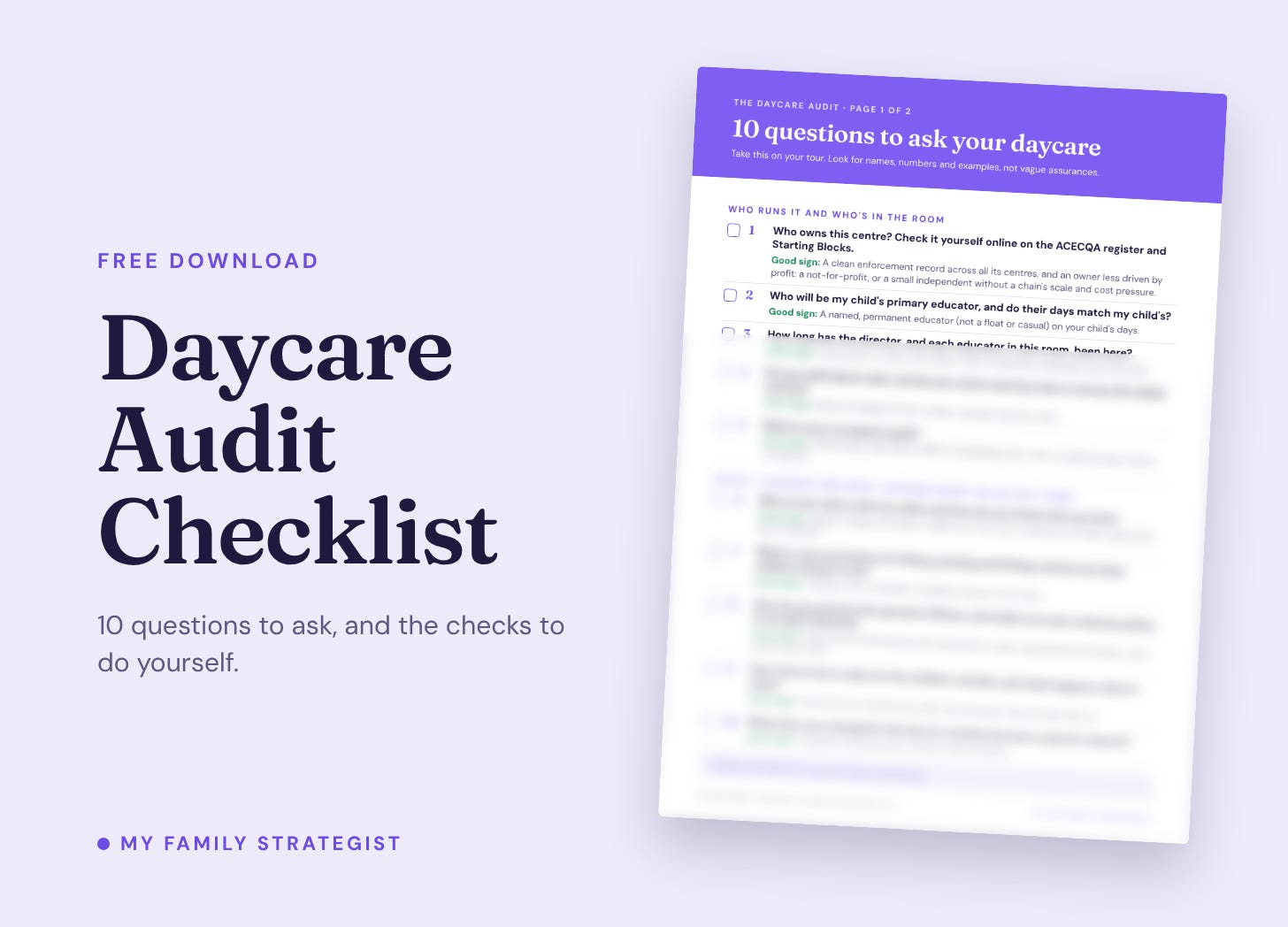
Subscribe to download your free checklist (it’s the whole series on 2 pages)
6. Who is ever alone with my child, and how do you check who you hire?
It’s actually five questions I’ve wrapped into one:
Where do nappy changes happen, and is that space visible to the rest of the room? (Take a look while on tour)
Who is in the sleep room, how often are sleeping children physically checked, and is that written down?
Does your screening cover everyone — educators, assistants, kitchen and admin staff, students and casuals?
Do you check references? If so, how?
Do all staff get first aid and CPR training, or just the minimum? The legal minimum is one qualified person in attendance at any time. But many centres train everybody, which is why it’s worth asking. CPR has to be redone every year.
Everyone working with children is legally required to hold a Working With Children Check, so there is no point asking whether staff have one. It also gives you much less assurance than you would think.
In NSW, the check lasts five years, and is continuously monitored, even if the holder changes jobs. But monitoring only catches what reaches the authorities. So if a complaint never becomes a charge, it doesn’t show up. In the case I covered in my last piece, accused child sex offender Joshua Dale Brown held a valid check. The ABC reported that authorities did not review it even after a complaint was made. The Royal Commission warned a decade ago that these checks give parents a false sense of comfort.
So the better question to ask is about references, which centres are not obliged to check at all. Ask if they actually call up previous employers. Someone who has moved through a lot of centres in a short time is a red flag.
7. What is your procedure for biting, pushing and hitting, and do you have children doing it now?
My son was bitten five times, by several different children, in the space of five months, and the daycare tried to tell me that was normal. The marks were so deep, it would often take 48 hours to fade. Sometimes they would even blame my child because he wasn’t sharing toys. He was only 18 months old.
We normalise biting, pushing and hitting in daycares, but the frequency, severity and circumstances make all the difference. Some of it is developmentally typical, but constant incidents are not. Children also don’t go from zero to a hundred. There are usually triggers and a build-up, and somebody is meant to be watching for it. When it happens over and over across a room, it is usually a symptom of overstimulated children and not enough supervision.
It may feel awkward to ask, but it’s worth knowing: are there children in this room biting at the moment, and how many? You aren’t asking anyone to be named. A centre that answers honestly is one you can work with.
If you get “we can’t discuss other children”, ask it a different way. Every incident has to be documented, so ask how many incident reports were written for that room last month.
Under the regulations all incidents must be documented and you have to be told within 24 hours. You should never be discovering a bruise yourself at bath time, or hearing on Friday about something that happened on Tuesday. So ask what happened the last time a child was hurt in that room, and how those parents found out.
8. How do you prevent the spread of illness and ensure your sickness policy is actually followed?
Every daycare has basically the same sickness policy on paper, so asking for it is much less helpful than asking about how the spread of illness is prevented and how sickness policies are actually followed — a much harder part for a daycare to uphold.
Here are the specific questions worth asking:
How often do you sanitise the toys, and who does it?
Do the children wash hands with soap and water before every meal, and is it supervised to make sure it’s done properly? The CDC is blunt about hand sanitiser not being a substitute for handwashing. Hand sanitiser does not protect you from norovirus (the common cause of gastro).
How are drink bottles kept separate? Is there a system that stops toddlers drinking out of each other’s?
How do parents report illness back to you, and how do you encourage them to do so?
When and how are parents told about an outbreak?
When are children sent home, and who makes that call?
I am continuously horrified by the sickness stories I hear from friends. Hospitalisations, breathing tubes, a child who nearly died — all from something picked up at daycare.
My son had 16 different viral and bacterial infections in his first 10 months of daycare, and my doctor assured me this was normal. He was right, because the Royal Children’s Hospital says a healthy child gets up to 12 viral illnesses a year, and doctors estimate a child in childcare can reach 20.
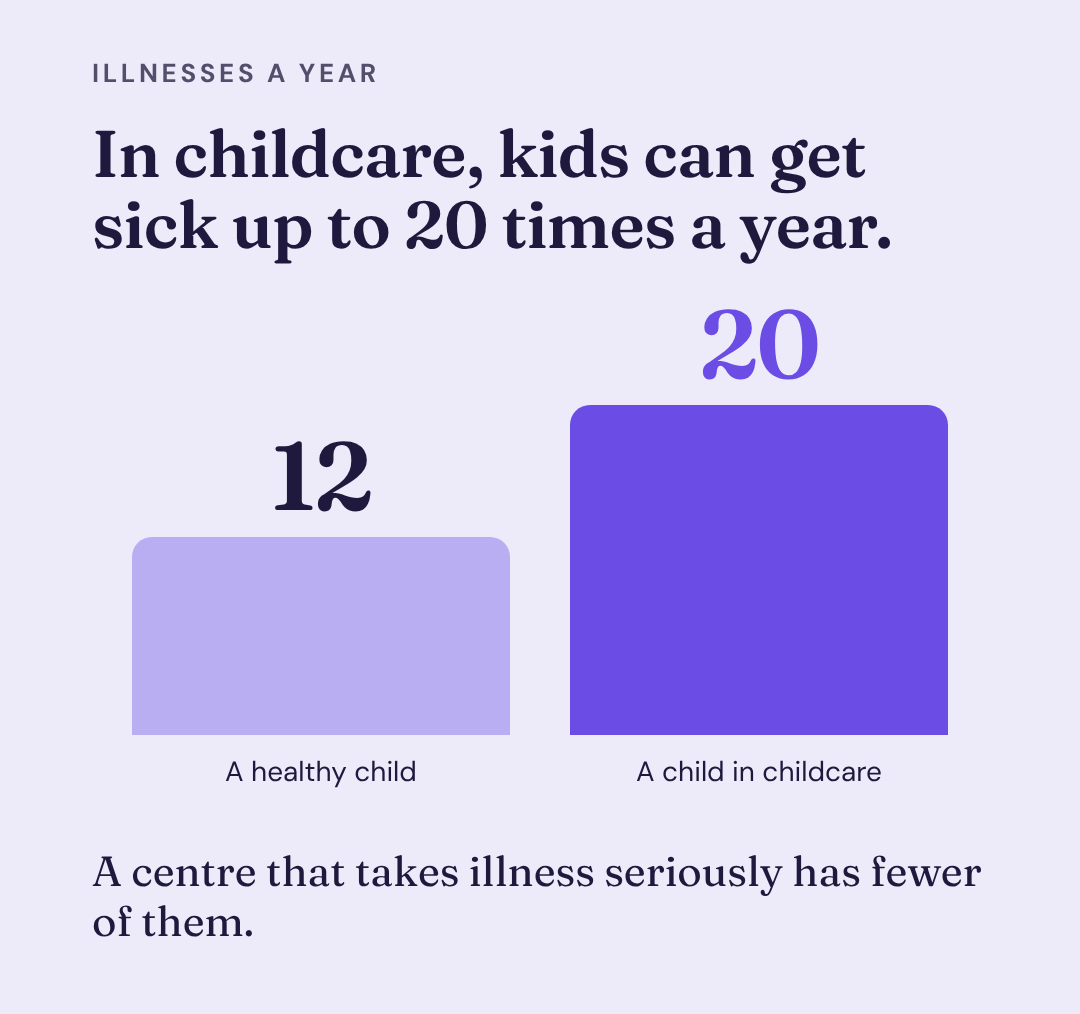
Somehow, we have collectively accepted that a small child being sick 20 times a year is simply the cost of childcare and there is nothing we can do about it.
But a centre that is thoughtful about reducing the spread of illness will have fewer sicknesses than one who does not. When I moved Lando to a centre with fewer children, more open space, proper handwashing and real time outdoors, the illnesses dropped away drastically.
I’ve seen some daycares accept children when they look half-dead. I’ve seen others be much more conservative, pay close attention and will call you to come and get them the moment they are unwell.
9. How many hours a day are the children outside, and what happens when it rains?
This one sounds soft, but it is the best proxy I have found for whether a centre has enough staff.
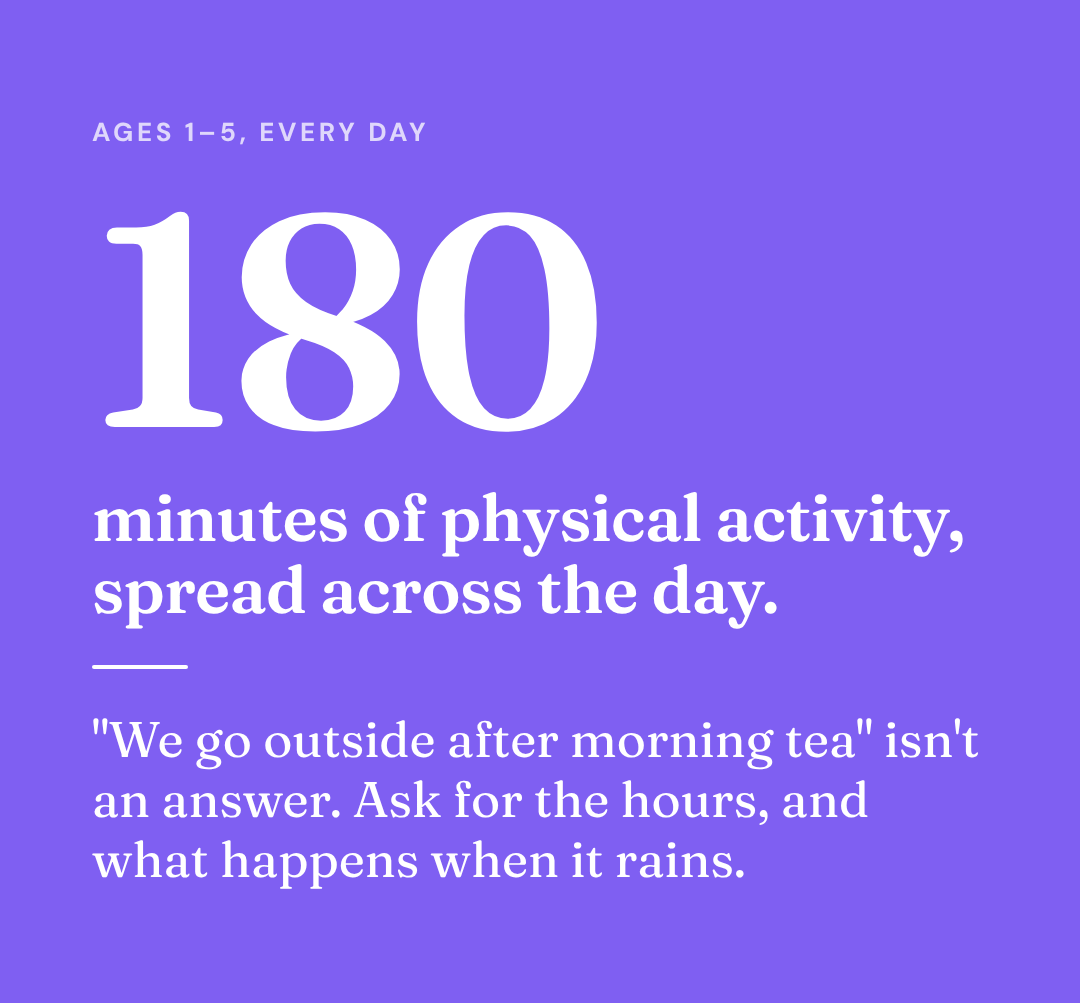
The Australian Government’s movement guidelines say children aged one to five need at least 180 minutes of physical activity spread across the day. So “we go outside after morning tea” isn’t a good answer.
At Lando’s first centre, if the ground was even slightly wet they stayed indoors all day. It was never a policy, it was understaffing. Taking a room full of toddlers out onto wet grass means muddy clothes, and muddy clothes mean changing them, and changing them takes hands they didn’t have.
At his second centre they were outside four and a half hours a day, every day. They did water play and let the kids get filthy. The children were happy, and he’d go through at least one outfit a day. He also got sick less, which made sense to me — they were spending far less of the day breathing the same indoor air.
So ask for the number of hours. Ask what happens when it’s wet. A centre that keeps children inside because it’s easier will give you a vague answer about the weather.
10. Tell me about something you changed in the last six months because a parent raised it.
This question gets to the root of how a centre responds to feedback. They all say “we welcome feedback”, but that is lip service if they can’t give you a single example of acting on it.
A good centre will act when the feedback is a genuine concern or a good idea. It will have a culture where parents raise things directly with the director as they come up, rather than once a year in a formal survey.
Lando’s first daycare heard my feedback plenty of times on safety and understaffing, and they did absolutely nothing about any of it.
His next centre actively sought parents out. When a parent said the rocks in the outdoor area were becoming a hazard, the director removed them. When another requested blinds for nap time, she installed them.
If they can’t come up with a single example, or they get defensive at being asked, you have your answer.
The one thing you don’t ask
If your child is already attending daycare, drop by unannounced and see what’s really going on. Regulation 157 says the provider must allow a parent to enter the premises at any time their child is being educated and cared for.
Swing by at midday because you forgot their hat, and have a look at what they’re eating for lunch. Or turn up late in the afternoon for an unexpected early pickup, when rooms are being consolidated, staff are changing over and everybody is tired.
I’m not saying make a habit of it, but do it at least once. These businesses have your children completely unobserved all day.
Every tour you will ever be given is at mid-morning, when the centre is fully staffed, the children are fresh, the room has just been reset and the director is on site. It is the best hour of that centre’s entire week, not a typical one.
It’s never too late to ask these questions — or to switch centres
I met a dad in the lift at Lando’s first daycare, not long after we enrolled. I asked him what he thought of our centre. He sighed and said, “Well. It’s the devil you know.”
That perfectly summarises what I see all the time in my parent community. We assume all daycares have turnover and sickness so we might as well stick with what we know. Add the fear of adjusting to a new centre, the possibility of worse tears at drop-off, the waitlists and the paperwork, and we’d rather stay somewhere we’re not happy with for months or years.
I’m sure that dad thought about switching centres — after every sickness, every incident, every bad drop-off. But he never did it, even though that daycare would have taken him back in a heartbeat if it didn’t work out.
Well I didn’t take his advice. Instead, I recognised switching daycares is a two-way door. So I experimented.
I moved Lando to a new centre and discovered that much better daycares actually do exist. I moved him from his large provider to a small independent centre he loved. Then when my schedule allowed for a small, low cost non-profit with short hours, I experimented again. This time by just moving him one day at first to see how he liked it. I told myself I would give it a try, and if he was unhappy, I could always just put him back in his original daycare. Enrolling him across two centres gave me the best perspective to compare and contrast experiences. My experimentation not only saved me $12,000 a year, it resulted in a much happier child.
Many of these questions I didn’t ask until my son was already enrolled — I didn’t have this checklist then. But it wasn’t too late because their answers gave me the information and validation I needed to switch. Sometimes it was uncomfortable to ask. Daycares seem to hold all the power with their long waitlists and I didn’t want to be labelled a Karen and have that reflect badly on Lando. So I understand the hesitation, but even asking three or four of these questions will likely give you a vibe so quickly, you’ll either be impressed or running for the door.
Read Next
I break down the daycare rating system, why it tells you much less than you think, and what to look at instead.

If I missed any questions in this week’s article, please pop them in the comments below so we can share with our parent community and make daycares better for everyone. In case you missed Part 1 - here it is:

— Christina