

The gap between the best and the worst daycare centre within a few streets of your house is enormous, and almost none of it is visible on a tour.
When my son Lando was close to moving into the 2-3 year old room at his old daycare, I decided to visit his new room at 9:30AM unannounced, intentionally choosing a time very few parents observe.
I counted 21 children and two completely overwhelmed educators. There should have been five educators for that age group. I saw three toddlers crying and not being attended to. One was face down on the floor sobbing. One toddler struck another for crying (as the educator clarified, this was because the children find the sound of crying distressing). One educator was trying to read a book to this chaotic room of 21 children, nearly yelling to get the story across since there was so much background noise. The other educator was wiping tables — a job that looked like it could wait.
I withdrew Lando that day. And my heart broke for those children and their parents who were at work and didn’t see what I saw.
You might think this was just a one-off. But according to a 2025 United Workers Union survey:
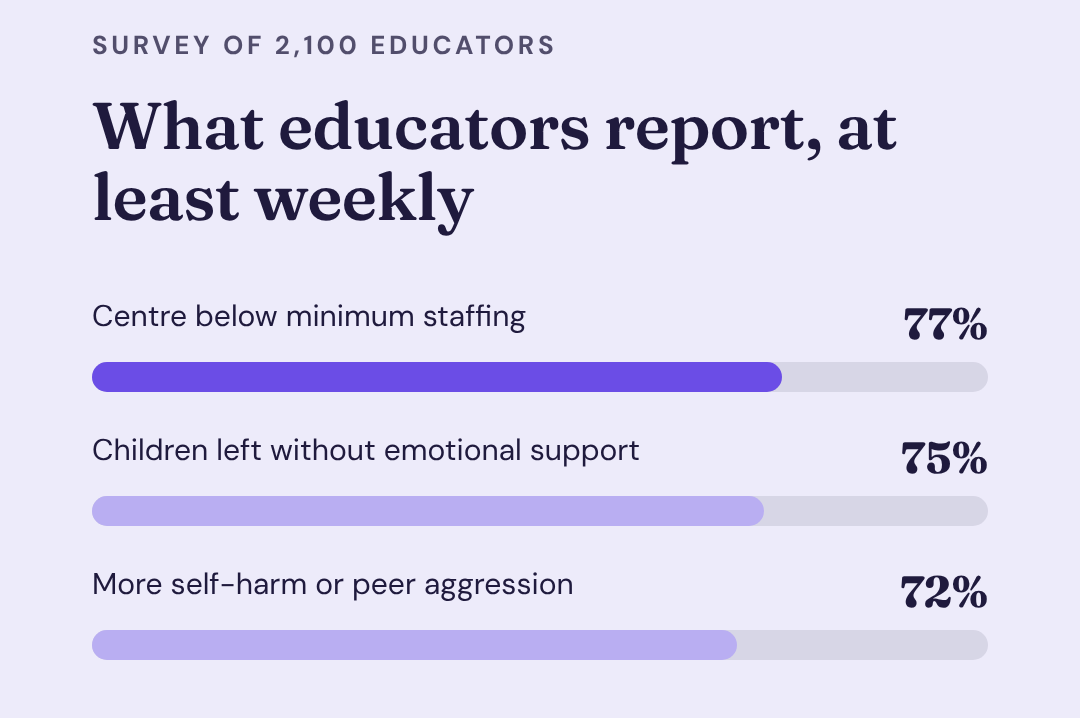
77% of workers reported their workplace operated below minimum staffing at least weekly.
75% reported children being left without emotional support.
72% reported increased self-harm or peer aggression.
It’s a more common scene than any of us would like, and I saw it all first-hand.
I spent eight years auditing businesses, then I had the real experience of being a parent navigating the broken daycare system. So now I audit daycares to correct this and help parents make more informed choices. With the benefit of hindsight and the knowledge I’ve accumulated in business, these are the ten questions I ask a daycare.
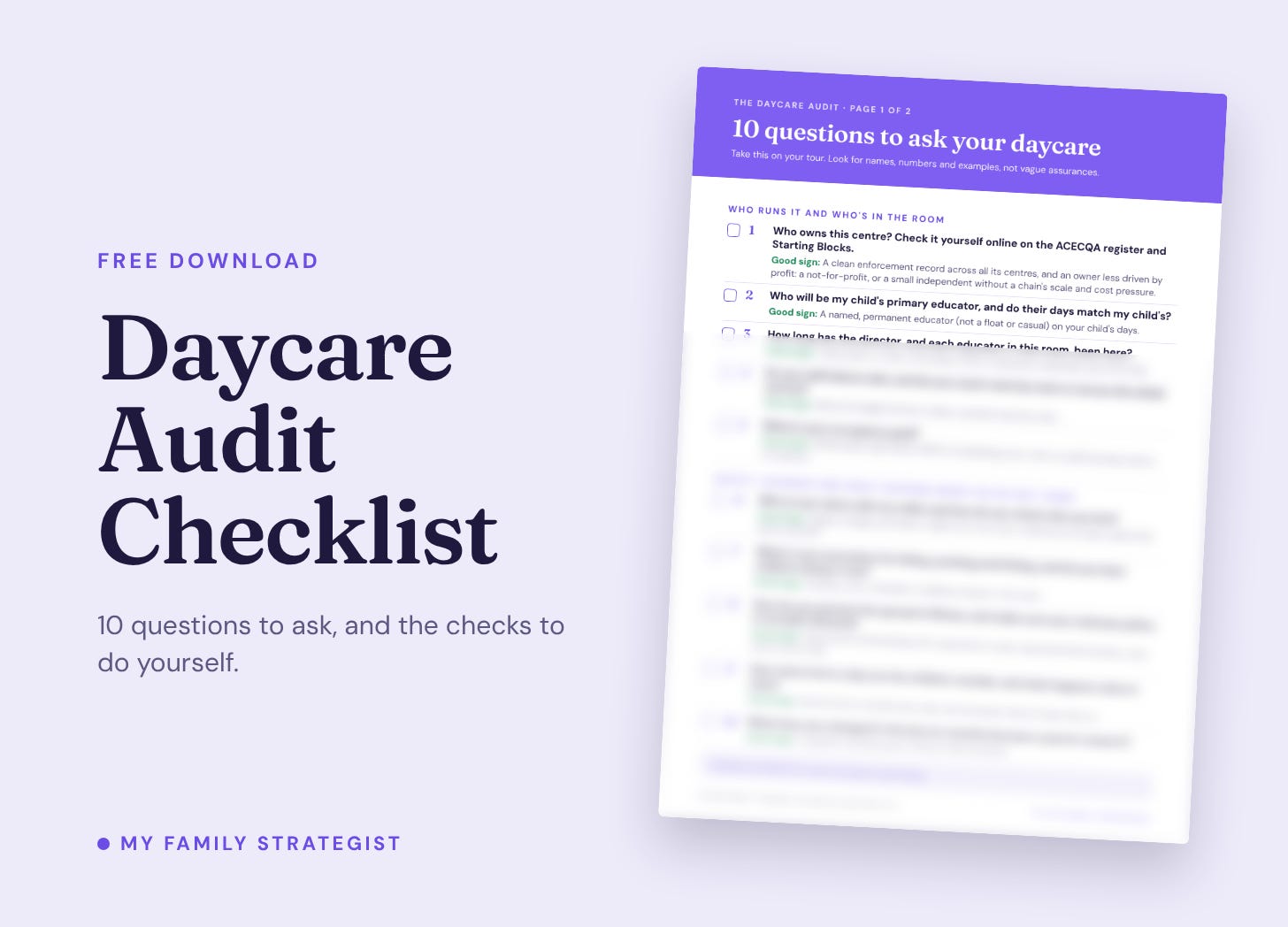
Subscribe below to receive your free checklist (it’s the whole series on 2 pages)
1. Who actually owns this daycare?
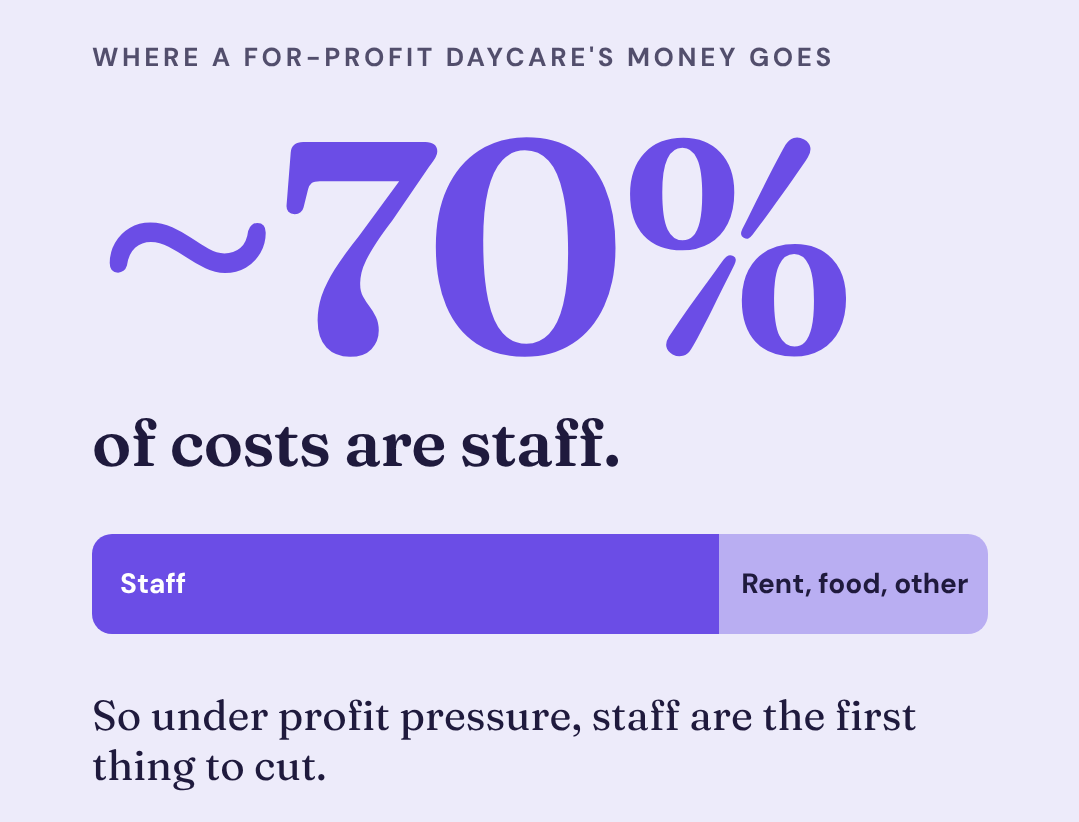
The reason why this matters, as I explained in my last piece Daycares: The Business of Children, is because the more profit driven the centre, the more incentivised it is to cut costs. And since labour makes up 69% of the cost of running a centre, it is by far the most effective place to cut. It is also the most damaging thing you can cut for your child because it translates into fewer staff, less qualified staff, or underpaid staff who leave.
You cannot easily tell who owns your centre from the outside. G8 Education runs more than 350 centres under a range of different brand names, and that is intentional, so a first time parent cannot easily tell that their local daycare with the nice logo is in fact part of a publicly listed company. Affinity runs 250 centres under several different names, is backed by private equity, and was bought by Quadrant in 2021 in a $650 million deal.
The clearest example of why this matters is the case of Joshua Dale Brown, who is before the Victorian courts charged with more than 150 offences relating to alleged child sexual abuse across multiple centres, including alleged offending at G8’s Creative Garden Early Learning Centre in Point Cook. Over eight years he worked at 23 different centres. Thirteen of them were owned by Affinity and four by G8. The daycare names changed constantly, but the owner changed far less often.
Two things to look up:
Are they for-profit or not-for-profit?
74% of long day care places in Australia are for-profit, so the odds are yes. Not-for-profits usually say so on their website because it’s a selling point. For-profits generally don’t, so you can verify it yourself on the ACECQA National Registers. If the provider name ends in “Pty Ltd” it is very likely for-profit. If you aren’t sure, you can always ask them to confirm.
Not-for-profits are not incentivised in the same way as for-profits. And not-for-profits consistently rate higher on the National Quality Standard (NQS) than for-profits, about 40% are “exceeding” for not-for-profits vs 15% for-profits (e61 Institute).
Are they independent, or a large provider?
Any provider running 25 or more services is classed as a large provider, which means they have to report their revenue, profits and leasing arrangements to the government, and you can see all of them on the Starting Blocks website.
Note the list of large providers is by owner only, not by the name on the door. For example, you'll find Affinity Education Group on it, but not Milestones — which is one of their daycares. So figure out who owns your centre first.
If it’s a single independently owned centre, or a chain with 20 centres, it won’t be on that list and it doesn’t have to tell anyone anything, but you can still search it there for its rating and any enforcement actions.
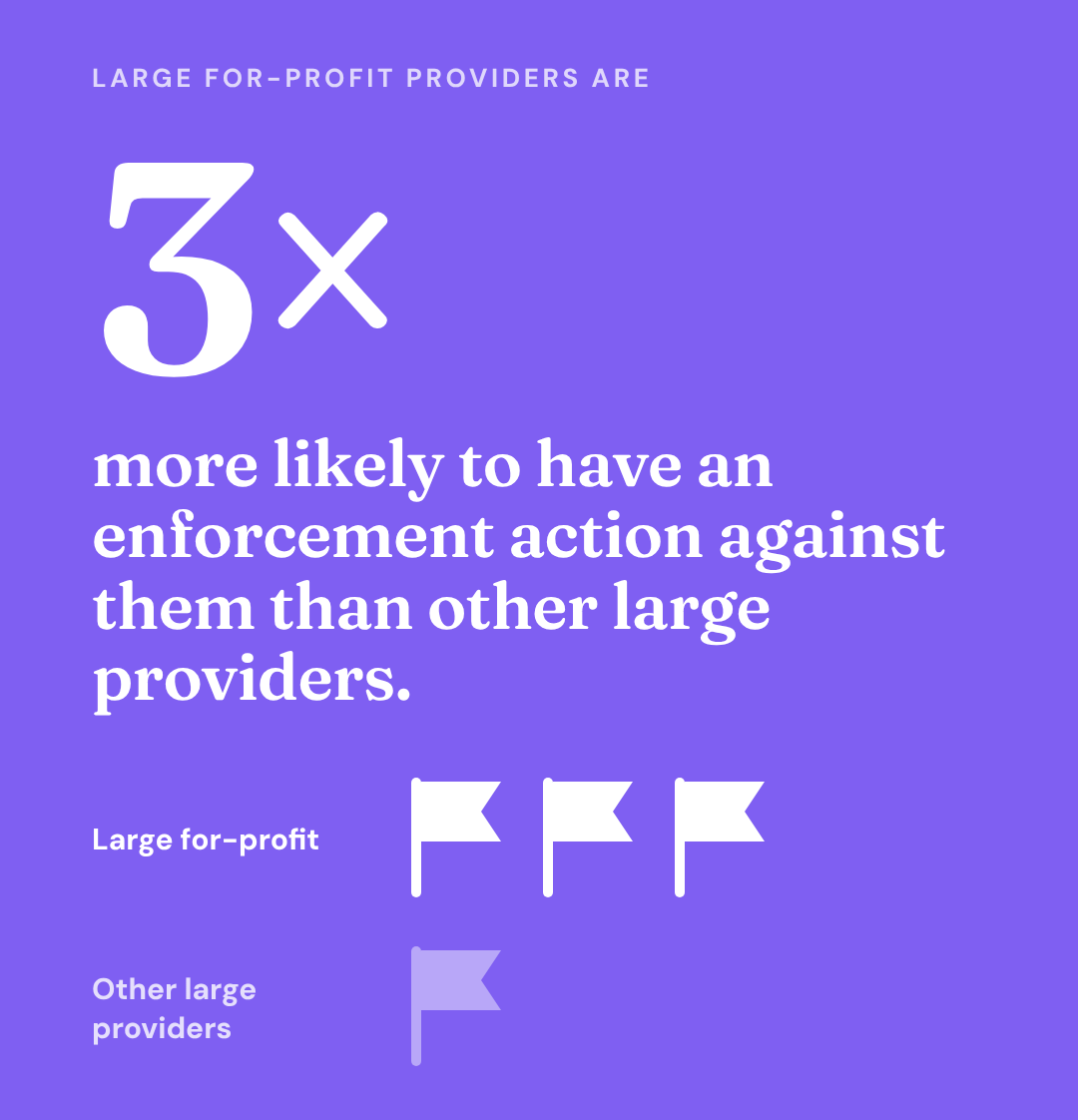
Large for-profit providers are more than three times as likely to have an enforcement action recorded against them as other large providers. (Mitchell Institute, 2026).
Scale and profit pressure together make breaches more likely, which is a good reason to check your specific centre’s enforcement history on the Starting Blocks page.
2. Will my child have the same educator every day?
Everyone knows to ask about turnover, but what is equally important is consistency.
A centre can have low turnover but your baby can still be cared for by multiple different educators each week.
This is because staff get moved between rooms and if they are working part-time, their days may not align perfectly with your child’s. They may have someone exceptional in your child’s room, but if they are working Monday to Wednesday when your child attends Wednesday to Friday, that is not very beneficial for you.
For-profit centres rely mainly on part-time staff, while not-for-profit centres employ far more people full-time. Part-time educators are often wonderful, but a heavily fragmented staff roster is more susceptible to operational cracks.
So ask who the primary educator for your child will be, how long they have been there, and what days they actually work.
While on tour, actually speak to your child’s educators privately. Ask them about themselves, how long have they been here, what did they do before, and if they enjoy working there. You are not looking for a particular answer so much as a vibe. If a centre steers you away from talking to the people in the room, that is its own answer.
Ask when room transitions happen and what the process is. A good centre transitions gradually, starting with a couple of hours a day and building up; and it happens when a child hits certain milestones rather than simply on their birthday or if they have new children starting that need their spot.
3. How long has the director, and each educator in this room, been here?
With turnover, you want to be specific. Because if you just ask “what is your turnover like?” — that leaves the door open for a vague answer like “it’s good” or “it’s low” which tells you nothing.
Ask which educators are in the room your child would be in, and then ask how long each of them has been there, name by name. That may seem overkill, but there shouldn’t be many. If it’s a laundry list of people in that room, it means they have plenty of part time or casual staff which is another problem already covered.
Ask how long the director has been there. A centre that has had three directors in two years has an issue somewhere.
Turnover across early childhood is high: it runs between 17 and 32% a year, against 12 to 20% for the Australian workforce generally. 70% of long day care educators have been at their current centre for three years or less.
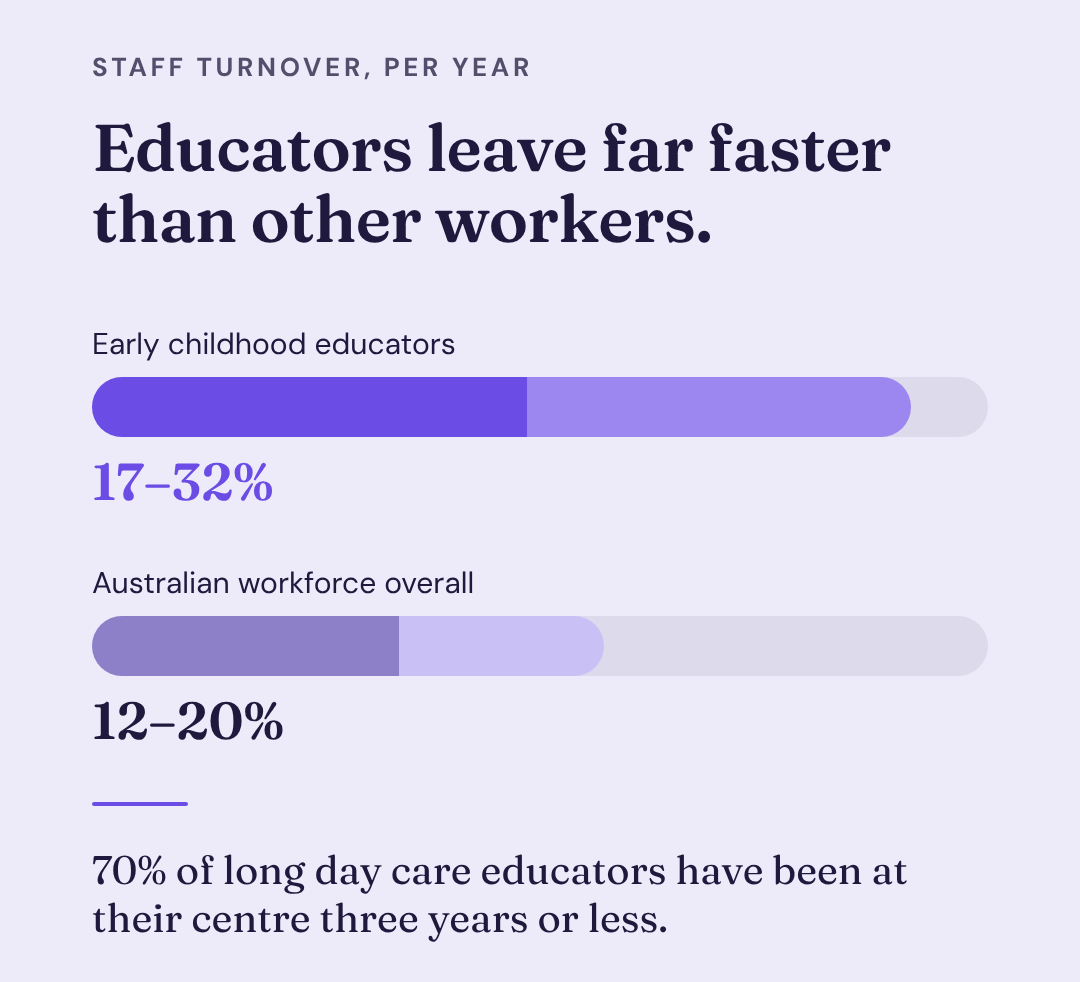
So the bar is low, but the benchmark helps you determine a good centre from a bad one. If anyone in that room has been there for three years, that actually puts them in the top third.
I knew I had struck gold when I found a not-for-profit for Lando where the newest educator had been there for four years, with the rest over a decade.
If they are all new because it is a new centre, that is a different type of risk. It means the centre is unproven, which doesn’t necessarily mean bad, but you will have to ask yourself if you want to be the guinea pig.
4. Do you staff above the minimum ratios, and do you count room by room or across the service?
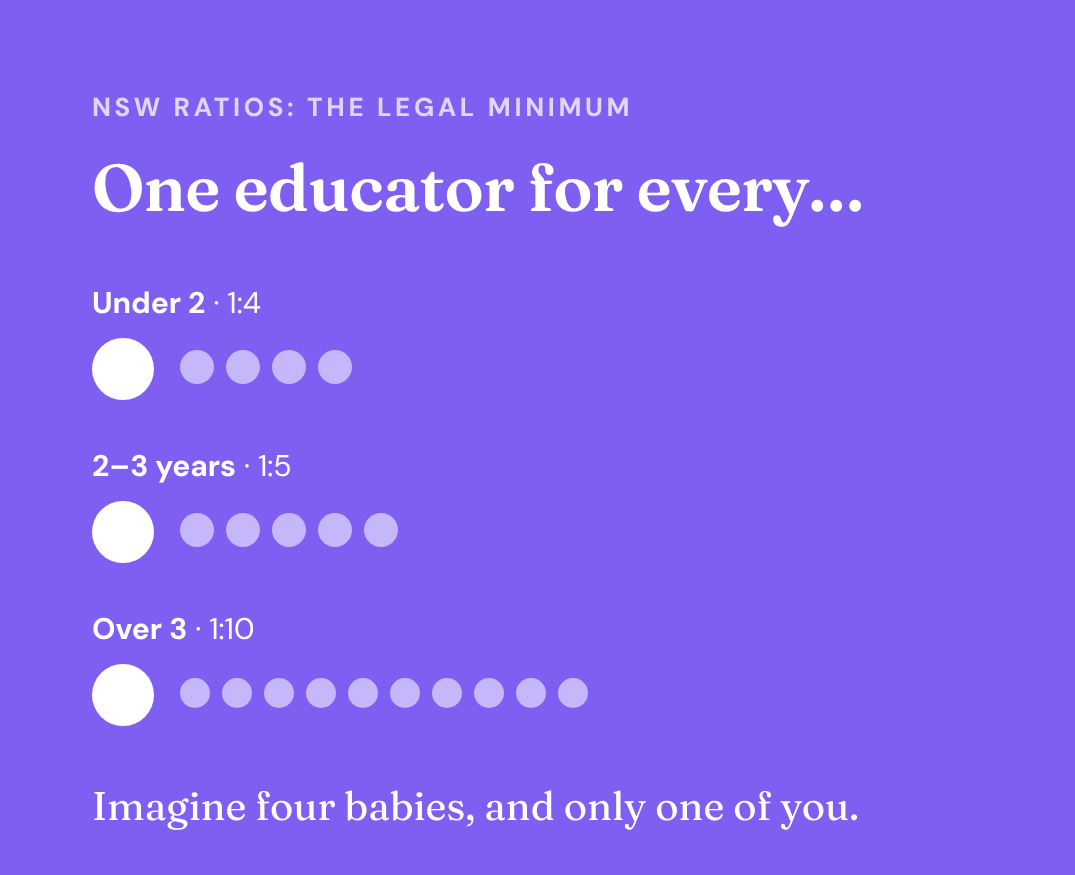
In NSW the rules for child to educator ratios are:
Babies under 2: 1:4
2-3 years: 1:5
3 years and over: 1:10 (nationally it’s 1:11)
I don’t know about you, but if someone handed me four babies I would find it very challenging to ensure all their needs are met at all times. If more than two are crying, I have a real problem on my hands. That is why especially for babies, if they staff above the ratio that is a good sign.
Legally, ratios are calculated across the whole service, not room by room. The industry calls this the “under the roof” rule, and it means a centre can be perfectly compliant on paper while your child’s actual room is short staffed at that moment, as long as there are staff somewhere else in the building. In the example I opened with — 21 toddlers and two staff – technically they may have been compliant because of this rule. But common sense will tell you that it was a clear breach of adequate supervision. If the daycare is an open-flow, small centre that’s less of an issue. But if it’s a large centre with closed separate rooms, having your child’s educator on the other side of the building is a problem.
If you ask this and get a vague response “we’re always above ratio”, there are a couple things worth following up on:
Are those extra staff regular, either full or part time? Keep in mind that if that extra set of hands is unfamiliar float staff, it affects consistency.
How do they cover breaks? All educators are entitled to breaks. In NSW, educators on planned breaks cannot be counted in ratio, but they can in some other states, including Queensland, Tasmania, South Australia and Western Australia. A centre that has thought about this will have a real answer for you. A centre that hasn’t will give you a jumbled one.
5. Do you always operate at full occupancy? What is your occupancy goal?
Under the regulations every child must have at least 3.25 square metres of unencumbered indoor space and 7 square metres of unencumbered outdoor space. Unencumbered means it does not include spaces like storage, toilets, nappy change rooms or staff rooms.
If a centre runs at full occupancy, it means every child may get as little as 1.8 metres by 1.8 metres (3.25 m²) inside. That’s not a lot of space.
This is a question I asked Lando’s old daycare, but several months too late. Their answer told me a lot about what the place was all about and it would have been helpful to know it upfront. “Yes, our goal is to operate at full occupancy.” She understood they were a business. Every absent child is money lost and every enrolment is money gained, so the room is full every single day of the year. That centre invested heavily into marketing, with frequent sign up offers and lots of ads to ensure it was always full.
Occupancy is also how some staff are rewarded too, through their bonus calculations. At a NSW parliamentary inquiry last year, G8 Education's bonus scheme for centre managers was described as a 10 per cent bonus, largely based on occupancy rates.
Keep in mind, operating at full occupancy is different to having a waitlist. A waitlist is an indicator of a daycare with a good reputation. A daycare can have a goal of 80%-90% occupancy, but still have a long waitlist because once they hit that threshold, they aren’t willing to go over.
It’s not inherently bad to run at full occupancy, but a centre aiming for 100% has no slack anywhere. A centre that deliberately runs below it has decided to spend money on breathing room instead, and your child is the one who gets to breathe.
Daycares are strange businesses
You are the customer, but your child is the one receiving the service, and for the first few years they cannot tell you anything about it. They can’t leave a Google review, they can’t recommend it to friends or family. If you enrol five days a week, they will spend more waking hours at this business than with you as their parents. That’s why it’s so important to ask the right questions and be as informed as possible.
The Daycare Audit — Part 2
Here are the remaining five questions which focus on sickness, safety and what is actually happening in the room. I also cover some helpful strategies to stay vigilant once already enrolled.
— Christina
If you find this information valuable, please share it with your parent friends and subscribe below to get notified when the next article drops.
Great points !!
Imagine daycares had a FAQ on their website that answered these questions: 1) would give parents comfort 2) could save their staff time in answering the same questions with every individual parent across all inquiries and tours 3) could help attract great educators and strong interest / demand from parents