

I had a mum friend who told me she’d only send her daughter to a centre that was “Exceeding” on the National Quality Standard (NQS). After all, it’s virtually the only metric parents have to evaluate a daycare centre.
Seems logical, but is it a good strategy?
I’ll save you the suspense: it’s not. That’s because the rating they have framed on the wall, that multi-coloured scorecard they have laminated at reception, it might describe a single day that happened five years ago, at a centre that has since changed owners, changed the director and has a completely different set of educators in your child’s room.
In this article we’re breaking down what the NQS is, what it actually assesses, where it falls short for parents, and how to tell a good centre from a bad one.
Whether you’re touring centres or perfectly happy with the one you’re in, this is for you.
What the rating actually is
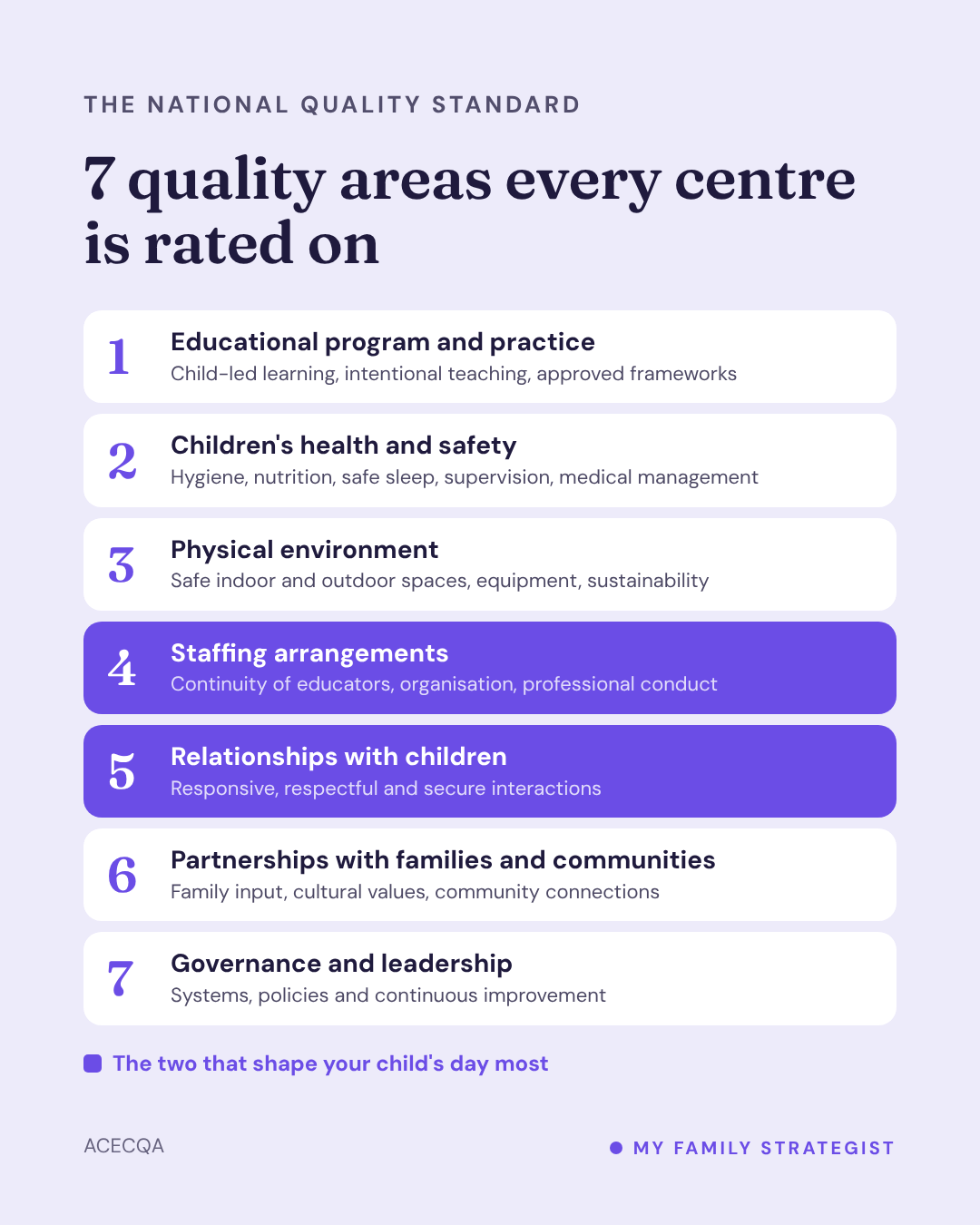
The National Quality Standard (NQS) is Australia’s national benchmark for early childhood care. It assesses seven quality areas, which are further broken down into 15 standards and 40 elements.
Assessment is done by your state or territory regulatory authority (e.g. in NSW, that’s the Early Learning Commission), not by ACECQA. ACECQA oversees the system and publishes the results.
The ratings
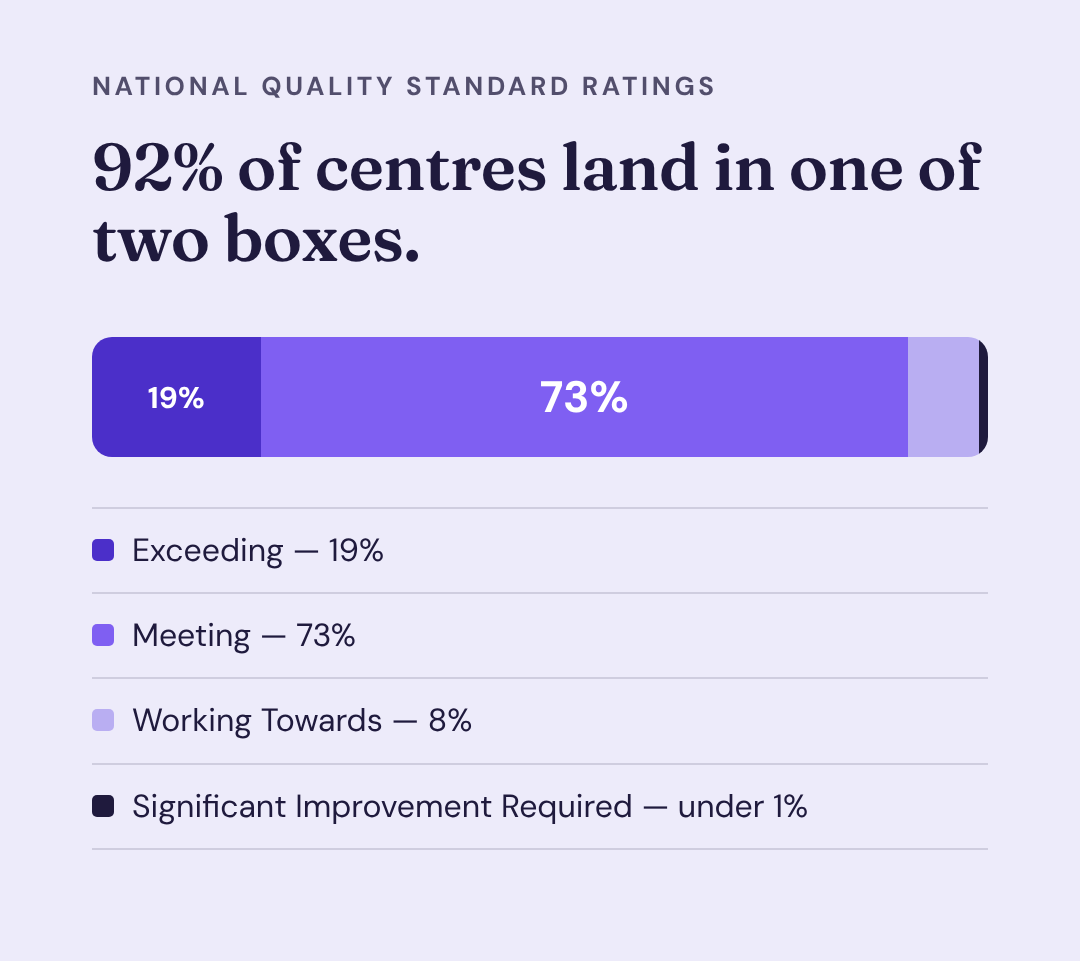
An assessment can produce four ratings. I’ve included the nationwide averages below.
Exceeding — 19% of services in Australia are rated Exceeding
Meeting — 73% are Meeting
Working Towards — 8% of services are meeting some elements with improvement plans
Significant Improvement Required — less than 1% have serious safety or wellbeing risks
A rating of “Excellent” occurs when a service was already rated Exceeding and applies to ACECQA for it, and it lasts five years. Only ~25 services in the entire country are rated Excellent.
How it’s scored
If one element is not met, while all other 39 are met, it can drag down the standard, then the quality area, then the entire service down to Working Towards. In that way it punishes any failure harshly.
On the other hand, to be rated Exceeding, a service needs every element met and at least four of the seven quality areas rated Exceeding. Three areas can sit at Meeting. The assessor also has to judge three things: that good practice is embedded in daily operations, reflected on, and shaped by families. It’s a subjective bar made by the assessor on that particular day or two that is observed. It seems fairly robust on the surface.
But here’s what nobody tells you:
1. “Meeting NQS” does not mean the service is good.
It only means that on the day the Assessor visited, nothing was found to be unmet. It is the absence of a finding, not the presence of quality.
It’s a bit like being told a restaurant passed its food safety inspection. It’s the default state of not having been caught at anything.
Centres also get a heads up that an assessor is coming, they receive up to five days’ notice of most assessment and rating visits.
2. Assessments are often outdated
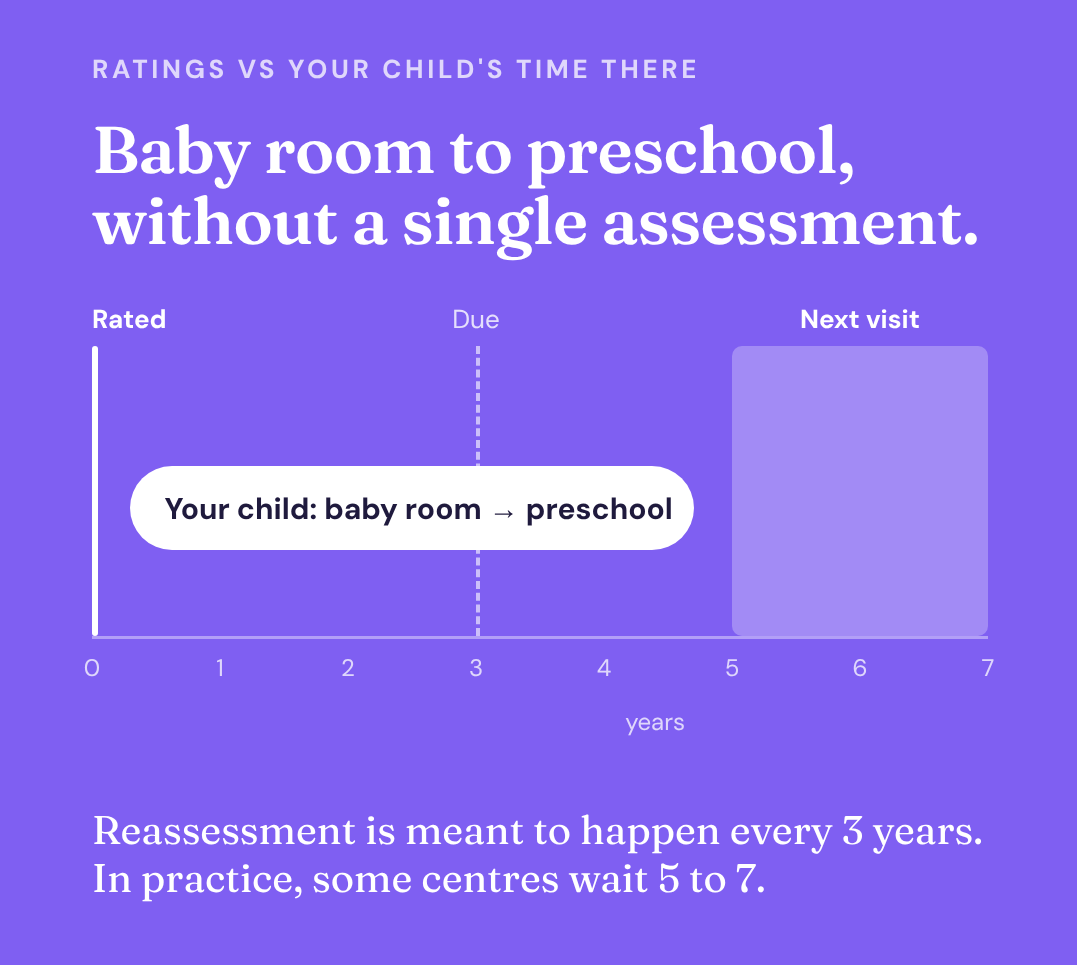
Regulators have a loose commitment to reassess a centre every three years, but in practice some centres are going five to seven years between visits.
That means your child technically could go through the centre, from baby to preschool, and never have the centre assessed once in that entire period.
Also, since for-profit centres change owners often, the rating you are reading may describe a centre with a different owner, a different director and a completely different set of educators
Tip: Check the rating’s date of your centre here. If it’s older than two years, it’s hardly relevant. And if it was before your child attended then it tells you nothing about their experience.
Tip: You will also see the date the centre was “last visited by regulatory authority”. If your centre was visited more recently than the rating date, that visit wasn't an assessment, meaning something else brought the regulator out. Ask the director what the visit was for.
3. The rating doesn’t cover staff ratios — and doesn’t change when they’re breached
At my son’s old daycare, the centre was regularly out of ratio and there was rarely enough supervision. I filed a complaint with the Department of Education. They kept their “Meeting” rating the entire time we were there; and they still have it today.
How can that be?
Educator-to-child ratios and minimum qualifications are not NQS elements. They’re set by the National Regulations and enforced through a separate process, although still managed within the same organisation. In NSW, the Early Learning Commission assesses centres against the NQS and handles ratio complaints.
A rating is a formal determination the provider can appeal, so it can only be changed by running the whole assessment process again. A breach can make the regulator more likely to reassess sooner, but it does not change the rating on its own.
Given the daycare gets up to five days’ notice of a visit, they’d have to be completely incompetent not to adequately staff on assessment day.
4. Nearly every centre has the same rating
92% of centres rated under the NQS are rated Meeting or Exceeding. That’s roughly 15,800 services — with completely different staff, culture, philosophies, physical spaces and leadership — falling into only two categories. If every centre near you has the same rating, it doesn’t help you choose between them.
I’ve enrolled across three centres, all rated Meeting.
One was exceptional.
One was good.
One was borderline neglectful.
It is also worth noting the split by ownership. The ACCC found 34% of not-for-profit, government and school-based services exceed the National Quality Standard, against 13% of for-profit services. The not-for-profit group includes most of Australia's preschools, which rate higher across the board, lifting that average. But because not-for-profits reinvest surplus revenue back into educators and centre resources rather than paying dividends to owners, they are more likely to invest in the things that lift quality above the minimum.
5. It doesn’t tell you anything about what is most important to parents
What shapes your child's experience more than anything is continuity of educators, and whether someone responds to them warmly and consistently. Great playgrounds and activities are nice to have, but it's the people who matter most.
That is assessed in Quality Area 4 (staffing arrangements) and Quality Area 5 (relationships with children). Element 4.1.2 requires that “every effort is made for children to experience continuity of educators”. However more than half of childcare jobs (52.4%) last less than a year, against 24.5% in schools.
A centre with experienced, calm and caring educators just shy of exceeding, and one sitting right above “working towards” with burnt out staff will get the same rating.
And even a centre that gets “Exceeding” may not necessarily perform well on staffing arrangements or relationships with children. It’s much easier to prop up the non-people categories and get “Exceeding” with things like a renovated outdoor space, a statement of philosophy, clean policies or current records. Those are also all things a service can prepare with five days’ notice.
6. The NQS rates the service, but your child lives in a room.
The baby room and the pre-school room can have different leads, different ratios, different turnover and a completely different energy, but they share the same rating. Any parent whose child has moved up a room knows this.
The NQS compresses an entire service into a single rating, when your child’s experience is based on their individual room.
If not the NQS, what are the signals of quality?
The main areas that predict quality according the research are:
Responsive, sustained interactions between educator and child. This is what collapses first when a centre is short-staffed or has frequent turnover.
Continuity of carer. The same person, over time, who knows your child. A centre can be Exceeding and still have replaced every educator in your child’s room since the assessment.
Ratios and group size. Smaller ratios mean more quality time with your child. If you have one educator to two babies, that’s obviously better than one educator to four (the legal minimum) or more. According to a 2025 United Workers Union survey, 77% of workers reported their workplace operated below minimum staffing at least weekly.
Qualifications and educator wellbeing. A burnt-out, underpaid, predominately casual workforce cannot deliver sustained responsive interaction. Median wage for long daycare educators is $34.30/hr vs $42.40 national median and $62 for schoolteachers.
This list really boils down into a small subset of what the NQS assesses (roughly a fifth of the assessment).
Why I’m not waiting for Government reform
Regulation moves slowly and almost none of it is in our control. The reform happening now is progress, but I know it won’t make any difference to my own son, who will outgrow the system in a year. So I’m not going to wait for it.
As parents, we don’t have to wait years for a regulator to check whether staffing is adequate or consistent on a random day. We can assess that ourselves every day, and much more effectively.
Do a headcount at drop-off and make sure there’s enough staff for the number of children. If there’s an unfamiliar face in your child’s room, ask the director who they are and whether they’re permanent. If someone leaves, ask why. If something isn’t safe, say so — in writing. If anything feels off, raise it. If it doesn’t get resolved, then leave.
If governments won’t hold centres accountable, we still can. Share this series to help other parents be informed, ask the right questions and choose a great daycare.
Figures current as at September 2026.
Super insightful breakdown of the NQS!
Reminds me of the health quality stars that you have on food products which can be an oversimplification of something very complex and nuanced