

When I told the parents at my daycare I was leaving after a string of safety incidents, serious ratio breaches and lack of supervision, I got one of two responses:
The first was: thank you for telling me. I thought I was the only one. Several of those families withdrew their children too.
The second was: that’s not my experience. Sorry that happened to you. Please say no more.
I don’t blame the second group. I might have said the same thing eight months earlier. But you and I were not looking at the same centre.
If you drop-off at 7.30am every morning, you never see 9.30am when all the children have arrived, and you have no idea whether the staffing kept up.
If you’ve never dropped in at lunchtime to see what the kids were actually eating, all you’d see is the menu in the app, which looks great.
When incidents happened, I requested the video footage, and I saw the gap between what I was told and what happened. Not many parents get to see the CCTV recording.
I documented and escalated every ratio breach. But if you don’t do the headcounts, how would you know if they were short an educator?
It wasn’t a difference of opinion. It was a difference in what we observed.
The uncomfortable truth is that none of us can ever really know what happens in the hours we aren’t there.
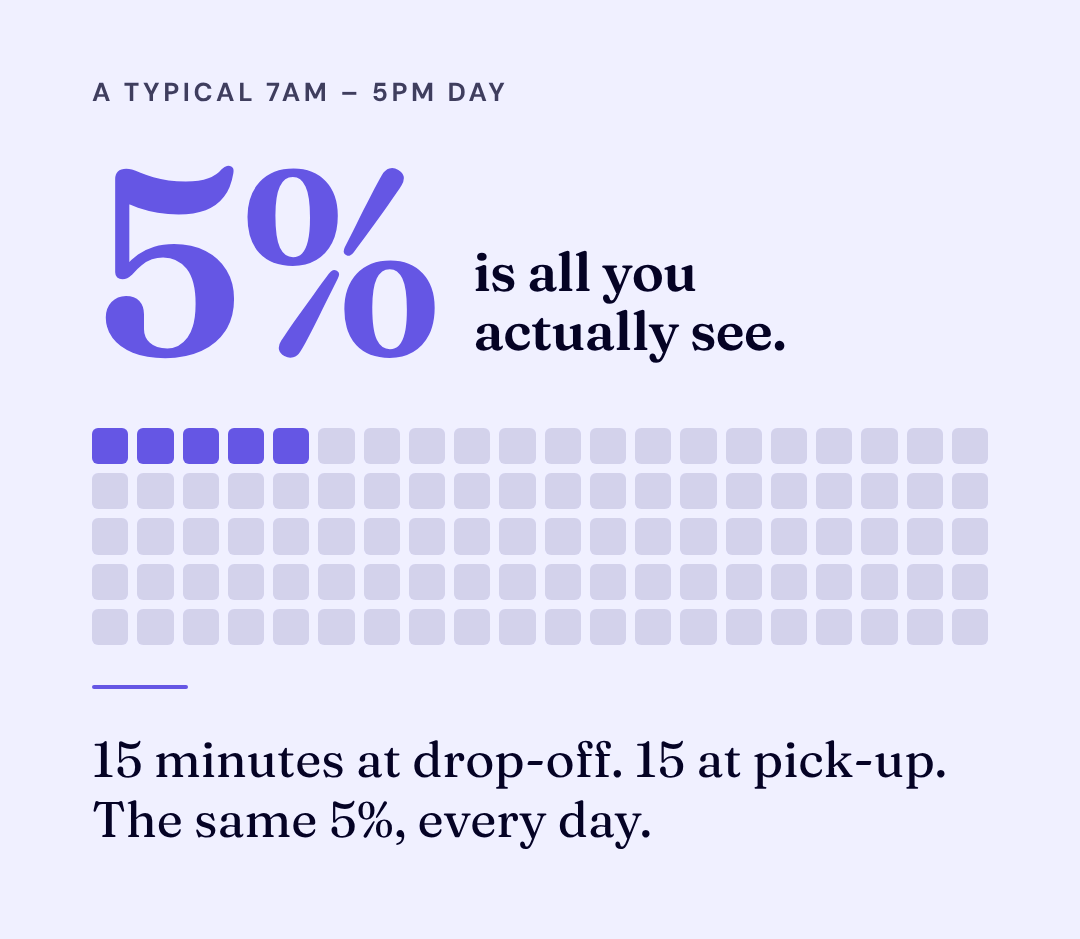
Most of us only see 15 minutes at drop-off and another 15 minutes at pick-up. If your child attends a typical 7am - 5pm day, that is only 5% of their day you are actually observing. If you do pick-up and drop-off at the same time every day, as most of us do, you are actually just observing the same 5% over and over again.
A lot can happen in the 95%. And people behave differently when they think no one is watching.
And both things can be true at once. The staff can be warm, know your dog’s name, and genuinely adore your child — and there can still be too few of them in the room.
When there are too few of them, the downstream issues inevitably follow. Feeding and sleep instructions get missed, dirty nappies sit unchanged and burnt-out staff leave. On the floor, a lack of supervision turns into safety incidents that nobody saw happen.
Worse yet, a lack of oversight creates blind spots where bad actors can move in and stay under the radar. Predators can also be nice. Which is disgusting to say, but charm is the tool they use. The Royal Commission’s own research found grooming targets not just children, but parents and staff too.
Why ‘Not My Centre’ is the normal psychological response
When we hear horror stories in the news, or even bad experiences from other parents, defending our centre is the normal reaction. We can’t help it. Our brains are wired to believe that bad things happen to others more than us.
Psychologists call it optimism bias. When people are asked to rate their own odds of something bad happening against everyone else’s, almost all of us put ourselves below average. But statistically, most of us are wrong.
I caught my own optimism bias earlier this month. It was during a conversation with my financial adviser on personal insurance. We were going through the whole list — life, income protection, trauma cover. “I’m healthy and young, I don’t need much,” I said. “That’s what everyone says,” he replied. “But I’ve been doing this for 20 years and no one expects to get heart disease or cancer. Ordinary bad things happen to everyone, all the time. No one thinks it will happen to them.”
When it comes to the first group of parents – the ones who said “I thought I was the only one” before withdrawing, there was a different psychological phenomenon at play. It happens when everyone privately has doubts, but everyone assumes they’re the only one, so nobody says anything. Since nobody says anything, the silence becomes evidence that everything is fine. Psychologists call this one ‘pluralistic ignorance’.
I knew something was off within a few weeks of enrolling. But I didn’t have any friends at the centre to validate me, so my first-time parent brain let self-doubt creep in. Back then, I didn’t understand I was navigating a multi-billion dollar industry full of problems operating under a completely broken economic model. And of course — I wanted to trust my centre.
Breaches happen every day. We only find out about a fraction of them.
In the for-profit childcare marketplace, operators are financially rewarded to cut costs. When nearly 70% of a childcare centre’s total expenses are labour (ACCC 2023), they are incentivised to staff it at the bare minimum of legal requirements. And sometimes even below that, with far too little consequence.
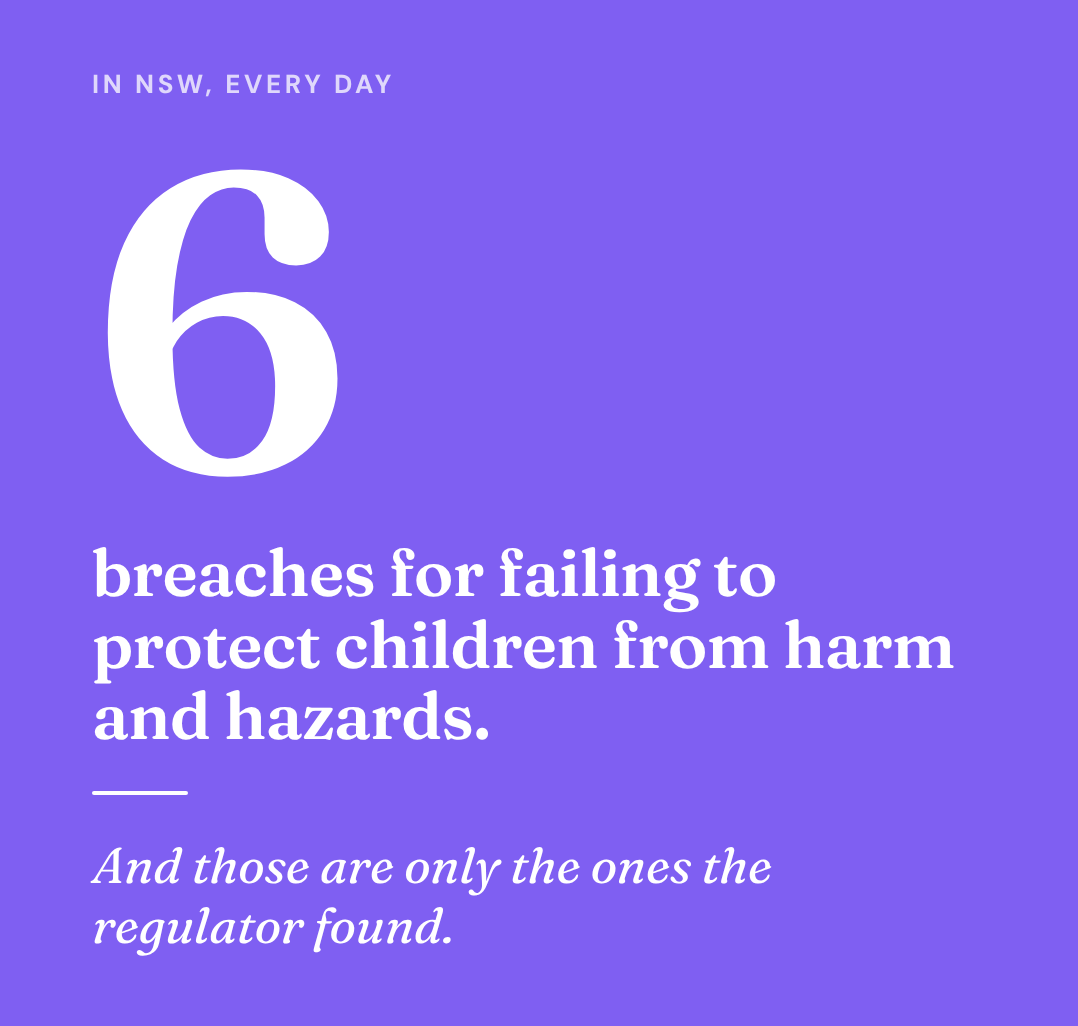
In the three months to June 2026, the NSW regulator recorded about three breaches a day for inadequate supervision, and six a day for failing to protect children from harm and hazards. And those are only the ones the regulator found.
My centre has no enforcement actions against it. I complained to the Department of Education with dates and details, and it still has a clean record. They didn’t say it didn’t happen. They told me they lacked documentary evidence to support it.
What it tells me as a parent is that there is a large gap between what is technically legally compliant on paper and what anyone with common sense would say is a good standard of care.
So when parents check the register and see nothing, that doesn’t mean nothing happened. It means nothing was recorded.
Trust, but verify
When I worked in corporate audit, we had a saying: “Trust, but verify.” You don’t wear a seatbelt because you expect to crash your car. You do it because the risk would be catastrophic if you were unprotected. You don’t do these checks because you’re trying to ‘gotcha’ your centre — you check because you aren’t willing to accept the risk of having blind trust in a business that has your pre-verbal child, completely unobserved all day.
And it helps the educators too
When we do these checks, we aren’t just making it safer for our own children. We’re making it safer for every other child at that centre, current and future. And for the educators. Yes, even them.
When I flagged understaffing to my centre’s leadership, one educator actually thanked me. It surprised me at first, and then I understood it — she didn’t want to work in an understaffed room any more than I wanted my son in one. Another educator used to urge me to keep advocating for my child.
Educators can’t easily ask their employer for more staff. There is an enormous power imbalance between an underpaid childcare worker and a centre owner who might be a multi-million dollar corporation. We’re the ones paying the bills, which means we have leverage they don’t. So when we check, and when we say something, we’re advocating for them too.
What you can do
Here are the things you can do to keep your child safe and your centre accountable. Most take no more than a few minutes. Many you need to check only once.
At your laptop:
Look up who owns your centre, its rating, and whether it has enforcement actions.
Request the name of every educator in your child’s room, what days they work, and how long they’ve been there, by email.
Put your name on another centre’s waitlist as a back-up. You don’t have to take the place.
At the centre:
Ask about the cameras, and go and look at where they are.
Take a look at the nappy change area, the bathrooms and the sleep room, and check the lines of sight.
Once in a while, turn up unannounced, or change the time of your drop-off or pick-up.
What to watch for:
Do a headcount at drop-off and pick-up.
When an educator leaves, ask why — and ask more than one person: the director, the owner, and the staff.
New face in the room? Ask for a profile, and whether they’re permanent or casual.
Notice when children disappear. Ask why they left, and ask more than one person.
Look at the photos closely. Are they staged or candid?
Get it on the record:
Never sign an incident report you haven’t read. Ask your questions first and request a copy.
Give feedback in writing, professionally and politely.
Talk to people:
Build real relationships with your child’s educators.
Make friends with the other families at your daycare and share notes.
Ask educators questions about your child. See if it matches how they are at home.
And if it’s still not working:
Trial another centre one or two days a week before you commit to leaving.
Next week
I’ll break down exactly how to do each one, why it matters, and the red flags that should sound the alarm. Subscribe to get notified when it drops.
So true! Focusing on the business angle means the forgotten focus of daycares ends up being the educators and the kids