

In February 2026 it was reported that the managing director of Little Zak’s Academy, a large Australian childcare provider, purchased a $56 million house in Sydney’s Vaucluse. He plans to knock it down and build a luxury harbour-view mansion for millions more.
About six months before that, a parliamentary inquiry heard that a child at the Newcastle Little Zak’s centre was found in a washing machine cupboard. Children at the Wollongong location fell out of cots because the rails were fitted wrong. In October 2025, two workers at the Doonside centre were charged over the alleged assault of a toddler.
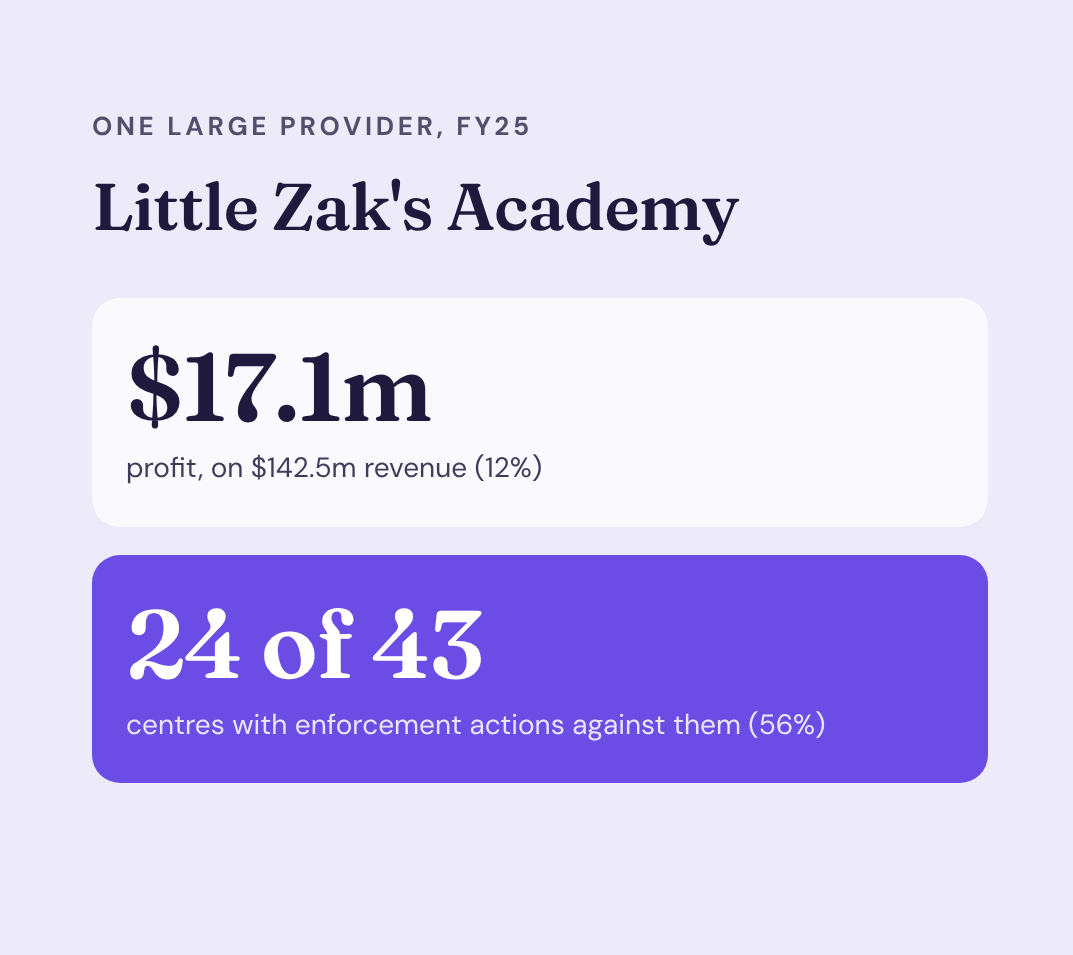
Little Zak’s recorded $142.5m in revenue and $17.1m in profit (12%) in FY25, yet more than half of their centres (56% or 24 out of 43 services) have enforcement actions against them. Both figures are published by the government, on its Starting Blocks website.
Tip: You can search for your own daycare here
How can this be? Unfortunately, it’s just the business model functioning exactly as designed.
In childcare, everything that makes a centre better for your child – more educators, more experienced educators, better food, more space – is a cost.
And as a society, we have decided to hand over the care of our youngest children to businesses that profit by spending less on them.
I have, regrettably, experienced this first-hand.
But as a first time parent, I didn’t know the questions to ask on a tour, I didn’t know the warning signs to look out for, I didn’t understand how important it was to know who owns your centre, how they operate and how they make money. I had blind optimism and no friends to tell me otherwise, because they didn’t fully understand it either.
That is why I am using my 15 years in business including eight as an auditor, plus all the mistakes I’ve learned first-hand to help parents make more informed decisions about childcare.
Why is daycare so expensive?
Australian childcare used to be substantially community-run: by councils, churches, parent committees and non-profits. Childcare services were subsidised based on staff wages (i.e. you only received the subsidy if the centre spent it on staff). Then a major funding change happened in the 90s. Instead of subsidising the services, the government changed to subsidise the child (the system that today is the childcare subsidy, or CCS).
So for the first time, money was attached to the child.
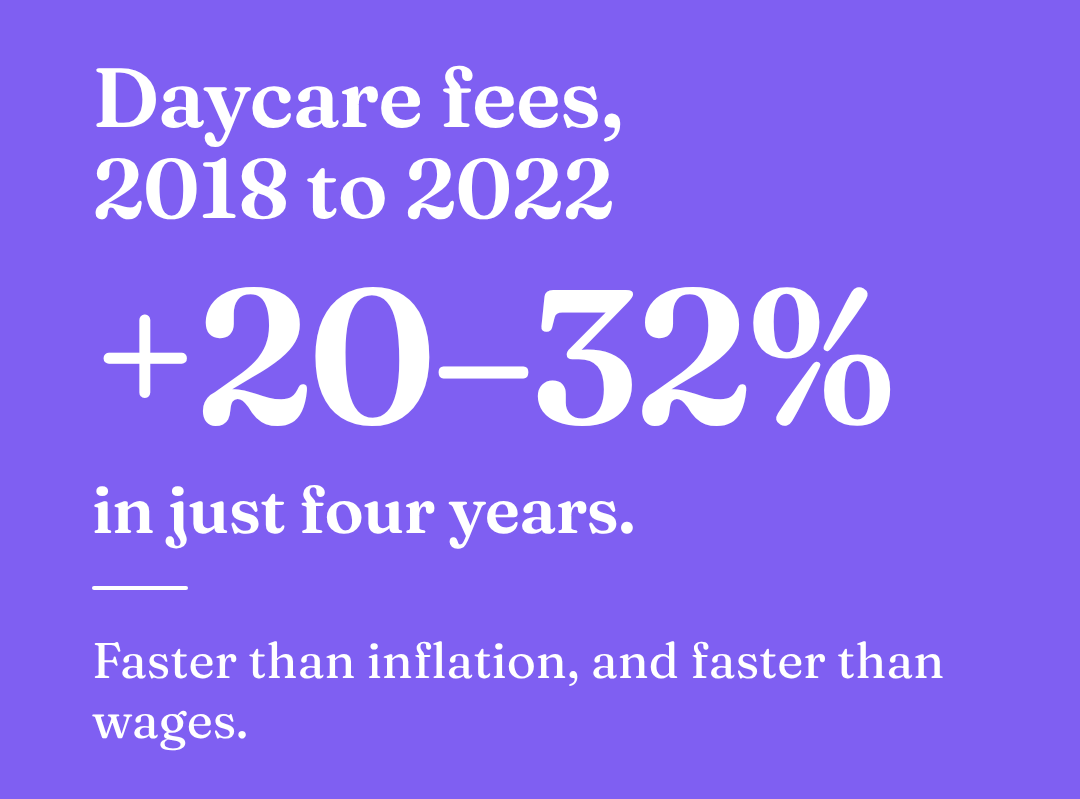
Private businesses could now claim it and the government stopped controlling how many centres opened. With more money in the pockets of consumers instead of centres, fees have grown faster than inflation and wages. Daycare fees rose 20–32% between 2018 and 2022.
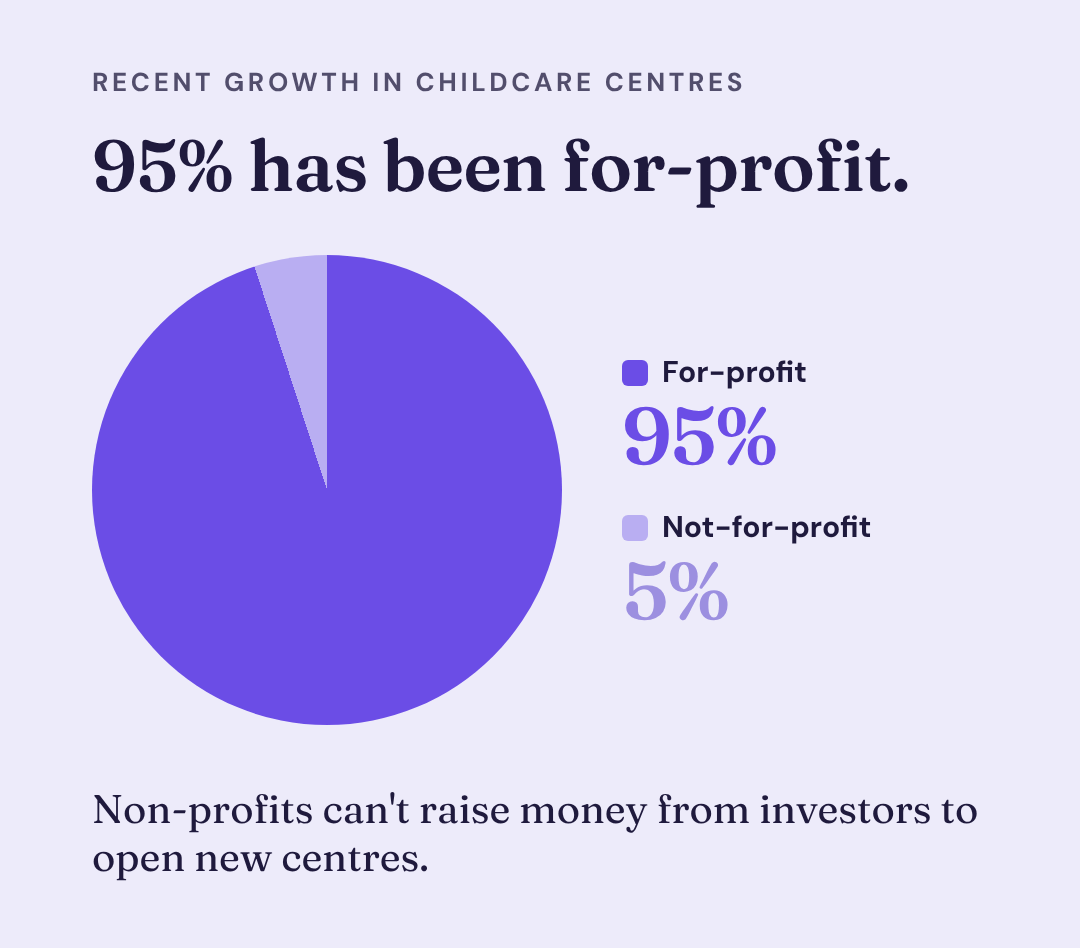
Roughly 95% of the growth in childcare centres has been for-profit (Australia Institute) and 74% of long day care places in Australia are held by private, for-profit providers (Mitchell Institute, Aug 2026). Meanwhile non-profit numbers have barely moved because capital grants to non-profits ended in the 90s and unlike for-profits, they can’t raise money from investors to open new centres.
How for-profit daycares work
It’s pretty simple: Profit = Revenue - Costs. The only way you improve profitability is by increasing revenue or decreasing costs. In the case of daycares, that means more children attending more often, or higher fees. Cutting costs is harder, because rent is fixed. Which leaves staff, food and consumables as the main levers. Here’s a simplified daycare profit formula:
Profit = (Children × Fees) − (Staff + Rent + Food + Everything else)
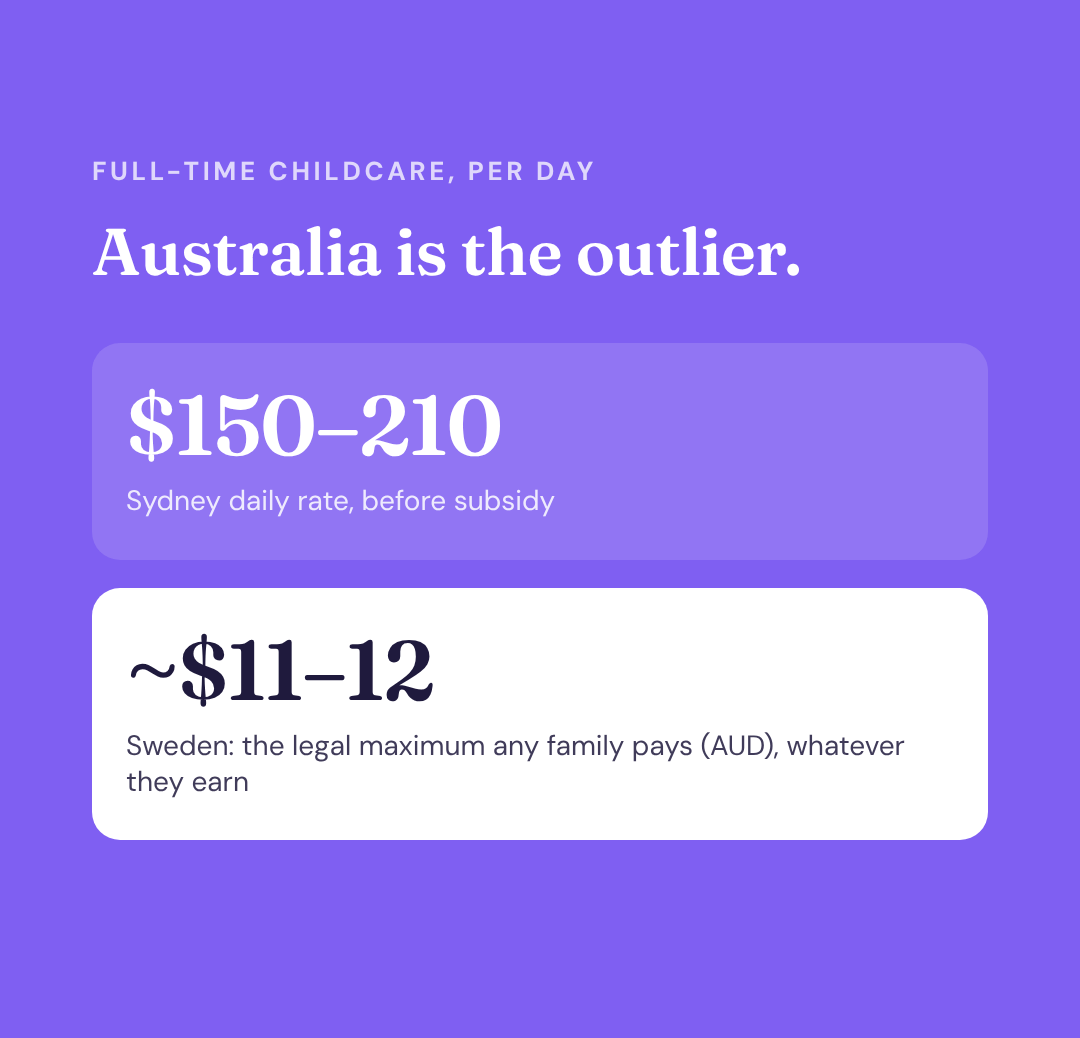
On fees: daycares charge a daily rate. In Sydney that’s roughly $150–$210 a day and it is standard to increase rates annually. You also pay for public holidays, your own holidays, and days your child is too sick to attend.
On children: daycares are naturally incentivised to run at maximum capacity. They prioritise children who can attend five days a week, and many set a minimum, like three days. Some push you to enrol at least one Monday or Friday. Mondays because that’s where most public holidays fall and Fridays because that’s the day everyone wants off.
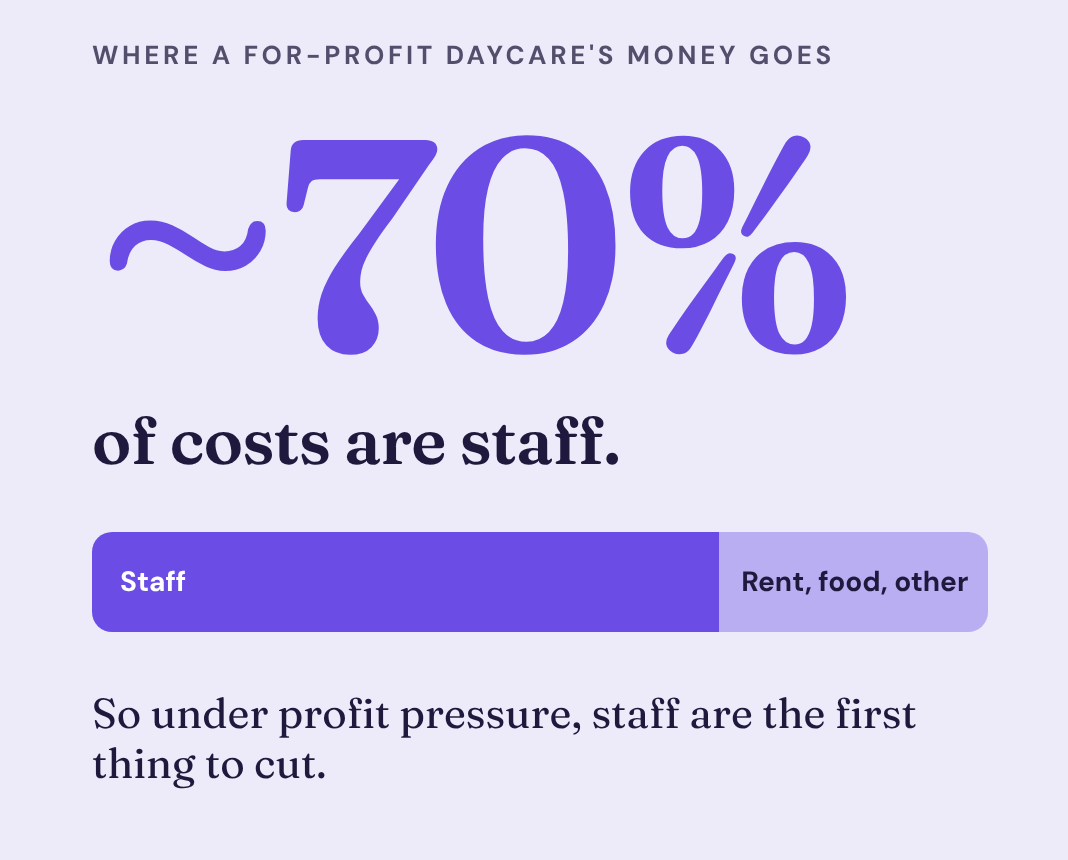
On staff: Labour represents ~70% of total costs for centre-based day care (ACCC, 2023), which makes it the most effective place to cut.
That can be done through:
Less competitive wages, or underpayment
Less experienced, more entry-level staff
Fewer staff altogether, running at the minimum required ratios or below them
In a 2025 United Workers Union survey of 2,100 educators, 77% said their centre operates below minimum staffing levels at least weekly. A shocking finding. Ratio breaches show up in the public enforcement register regularly.
Tip: One of the fastest and most effective things you can do as a parent is a quick headcount every time you visit. It only takes two minutes. Count the number of kids and the number of educators to see if they are meeting ratios. In NSW it’s 1:4 for under 2s, 1:5 for 2–3s, 1:10 for 3–5s. So for example, if there are ten babies in the baby room, they must have three educators to uphold the 1:4 ratio (10 ÷ 4 = 2.5, rounded up to 3). If they aren’t, report it to your centre (in writing) and the Department of Education to investigate.
Although technically under National Law (Regulation 123), ratios are calculated across the whole service at any given time, not strictly room-by-room. However, centres must ensure adequate supervision (Section 165) in every room. I used to do this at my son’s old centre. More often than not, they were out of ratio. It is a clear signal of a bad daycare you should not ignore.
On rent: Rent is the second biggest cost after wages, but it’s not a lever a centre can do much about, which puts pressure on cutting costs on the ones that can move, like staff and food.
On food: Lower quality ingredients and smaller portions are both effective ways to cut costs. A whistleblower told Four Corners that some Affinity centres were spending about 42 cents per meal, across four meals a day. At some centres it was as low as 33 cents. Research from the Queensland Brain Institute found 80% of children in audited centres weren’t getting adequate protein or vegetables.
Tip: If you can swing it, even just once, drop in unannounced at lunchtime and see what your child is actually eating. Under the National Law you have a right to enter the service at any time your child is there. I did this once when we were heading away on holidays and once when Lando was sick and I got a call for pickup. I could see why they’d report him eating three or four “servings” at lunch. A serving was more like a big spoonful from what I could tell.
On safety: Conducting proper background checks, interviews, reference checks, security cameras - it all takes time and money.
Not all centres are equally motivated to maximise revenue and cut costs. There is a big difference between a large multi-centre group and a single centre run by an owner-director who is there every day. Understanding who owns your centre, and how they make their money, tells you a lot about how it will be run.
Not-for-profits operate on an entirely different model.
Non-profits are run by parent committees, churches, charities and councils, which includes most community preschools. The ACCC found they face lower land costs and put the savings straight into staff, and 34% of not-for-profit, government and school services exceed the National Quality Standard compared to 13% of for-profit ones. But they’re becoming rarer, and their hours often don’t work for full-time working parents. I’ll come back to them later in the series when we explore alternative options.
Why the market can’t fix this
Daycares are unusual businesses that are not subject to market corrections the way other businesses are. There are three reasons for this:
The consumer is a child, mostly pre-verbal or barely verbal. If a typical business has consistently bad customer experiences, Google reviews would sort them out pretty quickly. But children can’t leave reviews, or recommend their centre to their friends and family. Of course the parents can, but all you see is 15 minutes at drop and pickup. The other 7-10 hours a day are completely unobserved.
The costs of switching are high. In a typical business, if you don’t like the product or service, you can cancel or switch fairly easily. Daycare placements can be limited, so you may have to navigate waitlists, sibling considerations, work schedules, paperwork and disrupt your routine. You cannot easily walk away or pull them out of care temporarily to find another centre when you are working.
The quality signal is broken. 73% of services are “Meeting NQS,” and they are only reassessed roughly every three years. It’s a blanket rating that doesn’t tell you much and becomes out of date quickly. Centres also get one to five days’ notice before an assessment visit, so it’s not a typical day they are observing, it’s a polished one.
Australia is the outlier
Across the OECD, early childhood education and care is overwhelmingly public: on average, about two-thirds of children attend public or community institutions. In Australia, we have flipped the model. Over 74% of our long day care places are run by private for-profit businesses.
While we do have public preschool in Australia, it’s about 15 hours a week and mainly for four-year-olds. That is not a system designed for working parents.
In Sweden, every child is entitled to a place from their first birthday, it’s open all year, full working days, and there’s a legal cap on what any parent can be charged. It works out to approximately $11–12 AUD a day for full-time care. That’s the maximum any family pays, no matter what they earn.
Other than googling “how to move to Sweden”, there are two useful things we can do: advocate for change, and learn how to work within the system as it exists.
The advocacy part is slower than any of us would like, but it is a right we often forget. You can email your MP and complain to your state regulator when something is wrong at your centre. You can share this post with other first-time parents to educate them and raise awareness. Regulators do investigate complaints, and it’s one of the few levers a parent actually has. I have done both of these things and it was easier than I expected. But it was also slow, frustrating and the outcome was out of my control.
Learning to work within the system is what this series is for. It’s faster and fully in your control.
Read Next
The top questions to ask your daycare, whether you’re enrolling for the first time or thinking about switching.

Subscribe to get notified when each drops :)
My blood was boiling on the Little Zak’s facts on your opener - great audit!