

When I was pregnant people would ask me what school I’d be sending my unborn child to. In Sydney, that is not an unreasonable question. If you don’t get on the private school waitlist before your child is walking, you won’t get in. Whether that’s clever marketing, fear-mongering or just reality, it fuels anxiety for parents all the same.
Hormonal, stressed and socially pressured, I agreed to $5,000 in non-refundable fees across five elite private schools to hold a high school placement for our one-year-old. It was an expensive way to feel better.
Well, we’re no longer planning to send him to any of those schools.
What changed is that I eventually sat down and analysed the decision properly. I set aside emotions, bias and social pressure and leaned on my fifteen years of solving strategy and numbers problems at work.
Businesses make complex, high-stakes, no-obvious-answer decisions constantly. They’ve built proper tools and frameworks for it, because the cost of getting it wrong is enormous. But our family decisions get none of that, even though the stakes are much higher. We so often let our emotions decide for us (my own cost us $5,000).
So I built DRIVE (a slightly embarrassing acronym I’ve made my peace with) to make better decisions. It’s five questions I ask before making any big family decision. Not all five are needed for every decision; they each serve a different purpose.
1) What does the data say?
Data — D in DRIVE
Data is about finding out what the evidence actually says, before you decide anything.
That sounds obvious. But in an era of misinformation, social media, old wives’ tales and no time to check any of it, it’s harder than it sounds. We also have a habit of racing to a decision before we’ve clearly stated the problem we’re trying to solve.
For example, most Sydney parents I speak with believe private school is worth it. Not one of them has evidence beyond their own experience, usually some version of the network argument.
A strategist would start somewhere else entirely. Not with “is private school worth it?” but with the questions underneath it that data can actually answer:
Are private school graduates better prepared for university?
Do they perform better throughout their degrees than public school graduates?
Does private school buy you a higher-earning network, and therefore greater opportunities?
Do private school graduates have better life outcomes — more money, success, titles, friendships or happiness?
I’ve now done that research. I’ll show you what it says in a few weeks, and how it changed my mind.
2) Is this decision reversible?
Reversibility — R in DRIVE
Reversibility separates the decisions you can undo from the ones you can’t.
It is used to triage decisions and determine how much mental energy a decision is worth. As I wrote about last week, in this complex age of modern parenting, giving every decision equal mental energy will lead to burnout.
In his early shareholder letters, Jeff Bezos split decisions into one-way doors and two-way doors. Most decisions, he argued, are two-way: if you walk through and don’t like it, you can walk back out. His warning was that decision paralysis comes from treating a two-way door like it only opens one way.
Having another child, buying a house, moving countries, starting private school — those are true one-way doors. You can’t undo them without significant pain and cost. They deserve the full DRIVE analysis.
But changing your baby’s sleep routine, hiring a babysitter, trying a meal delivery service or switching daycares are all two-way. So don’t overthink them. Move fast and experiment, because you’ll learn something either way.
To be clear, experimenting isn’t being reckless. You’re considering the change in the first place because something isn’t working, and that’s your signal to move. Understand the safe sleep guidelines, vet the babysitter or daycare properly, then decide quickly instead of wasting further time. If it’s a two-way door, the cost of being wrong is small and easily corrected.
3) What could go wrong, and what can I actually do about it?
Insurance — I in DRIVE
This question is for decisions with high uncertainty and low control. It does two things: it shows you what’s in your control, and it makes you plan for what isn’t.
You can’t control whether someone runs a red light into your car, but you can wear a seatbelt and insure your car anyway.
Businesses understand this so well that most large ones have an entire function dedicated to it. My first job at Google was in risk assessment, where asking that question was our entire mandate.
In parenting we do the opposite. We plan for the ideal and assume it’ll unfold that way. We overestimate how much control we have, given our children arrive with their own will and no interest in our plans.
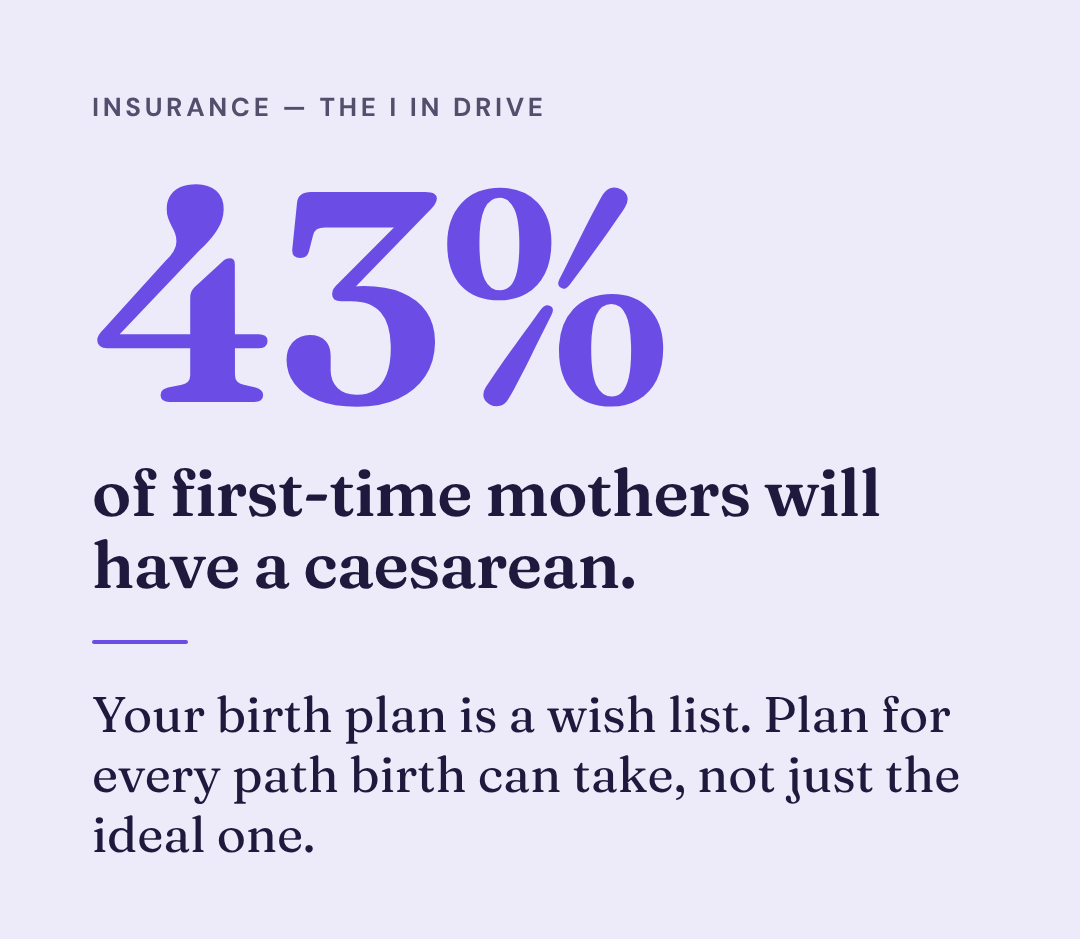
Birth is the first time we experience this illusion of control as parents. Nearly every first-time mother I speak to is planning a spontaneous vaginal birth with no interventions and minimal need for pain medication. But about 43% of first-time mothers will have a caesarean (AIHW, 2023).
You can’t control what happens in birth, so focus only on what you can: your expectations, and the conversations you have with your care provider before the day.
Throw out your birth plan — it’s a wish list. Instead, ask your care provider questions and understand the various paths birth can take, not just the ideal one, so you know how your care provider will respond when something changes instead of trying to figure it out in your most vulnerable moment.
That preparation is shown to reduce the odds of a traumatic birth, which affects around one in three women (Birth Trauma Australia).
4) What do we value?
Values — V in DRIVE
This one is for when you’re choosing between options that can’t easily be compared.
A nanny, long daycare, an au pair, grandparents, or extending your leave. Five options with very little in common, which is why a pros and cons list leaves you with five separate lists and no way to evaluate them.
The way out is counterintuitive: stop looking at your options. Figure out what your family actually values first, prioritise that list from dealbreaker to minor preference, then score each option objectively against it. It’s an exercise I call the ‘Values Matrix’, based on a management consulting tool I learned.
Most of us do this backwards. We evaluate the options and never reflect on our values at all, sometimes because we haven’t taken the time to think about them or get on the same page as our partners.
In the same way a company has a mission statement to guide its decisions, so should we have a Family Mission Statement that clearly articulates our values and acts as the compass for all our life decisions.
5) What is the true cost?
Economics — E in DRIVE
Economics is for the large, multi-year financial commitments, and it exists because the sticker price is almost never the real cost.
Back to our example of private school. The cost isn’t the tuition. It’s the building levies, the uniforms, the tech fees, the excursions, and the hidden one nobody talks about: the lifestyle inflation that comes with a high-consumption peer group.
A friend of mine recently spent nearly $2,000 on a mani-pedi birthday party for her six-year-old. She didn’t want to, but another mother at the school had set the benchmark with a $20,000 party a few months earlier.
Then there’s what that money would have done elsewhere over twenty years. That’s called the opportunity cost. It’s the number almost nobody calculates, but the one that gives the greatest perspective. For example:
How many years can we shave off our retirement if we don’t choose private schooling?
If we invested the fees in the stock market instead, how large a deposit could we provide for our child’s first home?
It sounds complex to run this analysis, but you don’t need a finance degree. I’ll use mine to break it down simply in the coming weeks, including the AI prompts that will model it all for you in seconds.
There’s no universally right answer to family decisions.
But these five questions lead you to ones that are informed, values-aligned and made with confidence.
We know exactly why we’re not sending Lando to an elite private school now. We can confidently articulate the data, numbers and family values that back it up, and we couldn’t before.
Another family could run the same five questions and land on private school. That’s the point.
Read Next
Each of the decisions I’ve used here — birth, daycare and private school — will get their own series and full DRIVE analysis soon.
I’m starting with daycare and asking “what could go wrong, and what can I actually do about it?” We all have high hopes for the place we entrust our children to, and it’s another perfect example of what we cannot control. So let’s focus on what we can. I’ll use my audit background to share the specific questions to ask a daycare, and how you can vet them properly when all you see is a tour and 15 minutes at drop-off and pick-up.

If you’re choosing a centre for the first time, or wondering whether to switch, the next few weeks are for you. Subscribe below.
The DRIVE framework provides such an amazing guide for those big decisions!