

Why do I struggle with one child while my parents and in-laws had four kids and made it look easy?
I looked at the data to figure out if it really is harder today or if it just feels that way. The answer is not what I expected.
The financial strain of parenting today
Let’s start with money because it underpins everything else.
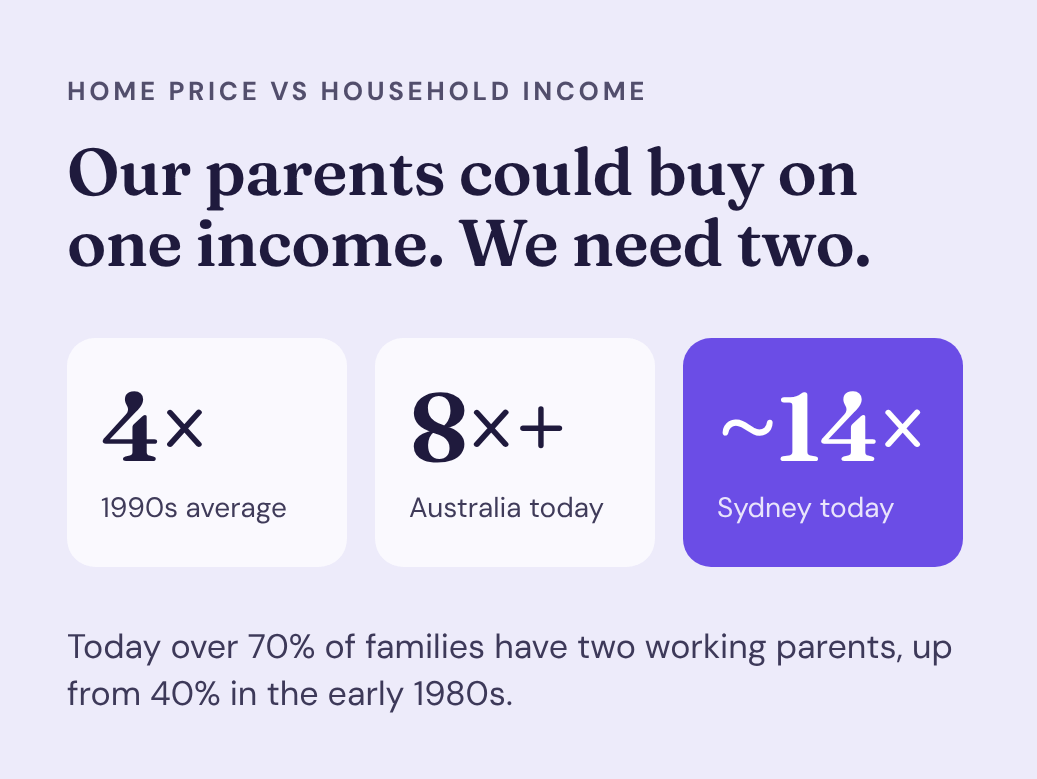
In the 1990s, the average Australian home cost around four times household income. Today it’s more than eight; in Sydney it’s closer to 14x. Our parents’ generation could buy a family home on one income and a normal job, which meant one person’s job was the home. Today, over 70% of families have two working parents, compared to only 40% in the early 1980s. For most families two incomes are not a choice, it’s what your mortgage or rent requires.
And because we have to work, we need more childcare. Today that is a cost, quality and availability problem. Around 35% of Australians, about 9 million people, live in a “childcare desert”, a neighbourhood with more than three children for every available place. My friends got on a daycare waitlist in Sydney’s Inner West when they were pregnant, only to be told they don’t have any chance of getting in, two years later.
Many of these problems have arisen because the childcare sector itself completely changed in a generation. It used to be substantially community-run: by councils, churches, parent committees and non-profits. Today roughly 95% of the 300 to 400 new centres opening each year are for-profit. It’s the business of children, and businesses have to make money. In high-demand metro areas, full-time care can reach $36,000 a year for one child in full-time care, before subsidy. In Sydney and Melbourne it runs well above that; and the subsidy is not for everyone.
We are parenting MORE, on top of work
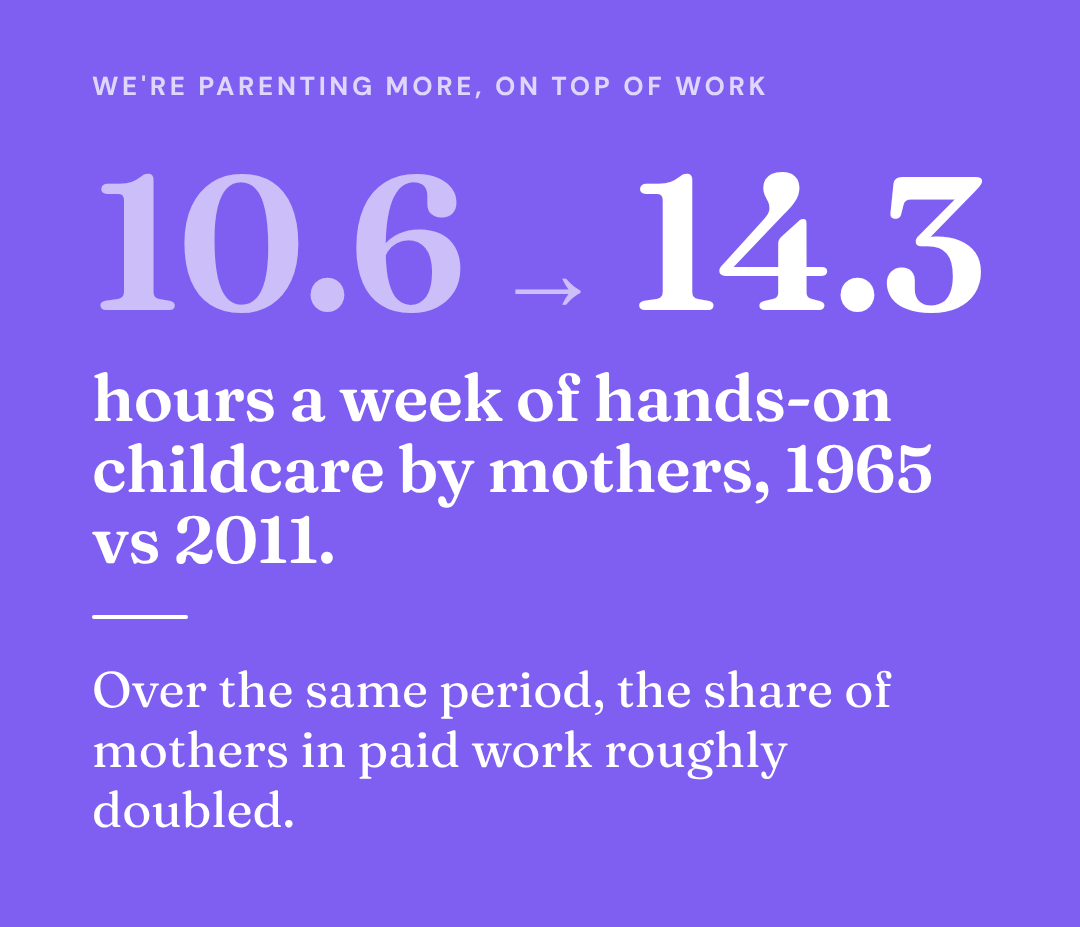
Despite more mothers being in paid work, mothers today spend more hours actively parenting than mothers did in the 1960s.
In the United States, where this data goes back furthest, married mothers’ time on hands-on childcare rose from about 10.6 hours a week in 1965 to 14.3 hours in 2011. Over the same period, the amount of mothers in paid work roughly doubled.
According to sociologist Suzanne Bianchi, mothers in the past were in the home, but they weren’t necessarily focused on the children. Kids were sent outside to entertain each other. I don’t have any memories of playing with my own parents. I played with my siblings and the neighbourhood kids, and occasionally we rode our bikes down the street to visit our grandparents, who were always home and happy to see us.
Grandparents today are not as available, although they still make up the largest source of unpaid help in Australia. The share of Australian children in informal care, mostly with grandparents, fell from 31% in 1996 to 19% in 2017, while workforce participation for 55 to 64 year olds climbed from roughly 45% to 67%. Many of them are still working. They are also healthier, busier and have lives of their own.
Additionally, nearly a third of Australians were born overseas, including myself having been born in Canada. This is up from a quarter two decades ago which means many grandparents don’t reside in the same city or country as their grandkids. My own mother would love to help out more, if she didn’t have to travel 20 hours on a plane to do so.
The job description changed
The goalpost of parenting has also moved. It used to be pretty simple: keep the kids fed, clothed and alive.
Now we’re expected to understand nutrition, development, behaviour and mental health. We know that responsive, consistent care in the early years shapes how a child handles stress for years afterwards. We have to be calm at all times because small children can’t regulate themselves and co-regulate with us. So we’ve had to re-parent ourselves at the same time as parenting our children, to stop whatever we inherited from being passed onto the next generation. It’s the part of the job nobody warns you about, because you can’t see it until you’re already in it.
On the other hand, we take for granted the ways in which parenting got much easier
We quickly forget that Australian infant mortality has more than halved since 1990 and SIDS deaths have dropped roughly 85% since the safe sleeping campaigns began in 1991. Vaccines that didn’t exist in our childhoods are now routine, and childhood cancer survival has been transformed.
Cars are safer and consumer products are strictly regulated. We have rear-facing car seats, ISOFIX, mandatory Australian standards for cots and prams and button battery regulations.
A child with ADHD, autism or dyslexia actually gets a diagnosis and support now instead of being called naughty or difficult.
Fathers are much more involved now too. Paternal childcare time has roughly tripled since the 60s. It means a child now has two adults paying attention instead of one, and a mother who is not the sole point of failure in the household.
And family life got more convenient. My mother used cloth nappies for her first child and spent the entire day grocery shopping and cooking for our family of six. I have disposable nappies, online grocery and meal kits.
So which is it?
The answer is more nuanced. It got safer and more convenient, but emotionally, financially and mentally it got a lot more complex and expensive.
But what complexity actually looks like, day to day, is decisions. More of them, and more expensive ones.
The loud decisions
Because of advancements in medicine, safety standards and research, we have to make a lot more parenting decisions about feeding, sleep, screens, safety, health and behaviour. I call these loud decisions because they are everywhere and well talked about in parent forums and group chats. This is where the information overload can drown you.
I had an allergen roadmap stuck to my fridge when Lando was a baby. Each of the nine allergens, how many times he’d been exposed, how often he was meant to have it again, ticked off one by one: shellfish, sesame, egg. I asked my mother when I’d had my allergens introduced and she said, “I have no idea. We didn’t have to do this.”
I also had to make sure I was giving Lando his probiotics, iron-rich foods and vitamin D supplements. And because we know so much about pesticides and microplastics, the grocery store has become a minefield. We need organic food but not when it’s wrapped in plastic. We need to read all the labels and know better than to trust marketing claims. I recently replaced all my non-stick pans with stainless steel, so I now spend twenty minutes every night scraping food off the bottom of them, in the hope that Lando doesn’t get cancer in his forties.
Sleep is the same overwhelm in a different flavour. Should we do Ferber, the chair method, or nothing and never sleep again? Blackout curtains or white noise machines? Wake windows or let them lead? If we want to co-sleep, there’s a ten-step process to make sure it’s safe. Should I pay for the premium subscription of my baby monitor so I can get detailed sleep reports and obsess over his weekly average? Obviously, yes. Meanwhile our parents got to enjoy the blissful ignorance of a room down the hallway and a closed door.
The loud decisions exploded in our generation. But they have one thing in common: there is usually good evidence pointing to an answer. Safe co-sleeping rules are documented, vaccine schedules are clear, allergen guidance is published. You just have to spend an enormous amount of time finding and reading the right sources.
The quiet decisions
Then there are the quiet decisions. These didn’t change in a generation. They are the same questions, but with 10x the consequence, largely because economics changed so drastically.
Nanny, daycare, or one of us stays home?
Do we keep renting, buy or rent-vest?
Do I step away from my career, and for how long?
Is private school worth it?
I call these quiet decisions because they drain your bank account silently, and because money isn’t very comfortable to talk about.
These are the decisions we often give the least mental energy to, because we’ve spent it all on the loud ones and we’re exhausted. So the quiet ones often get made by default instead of with rigorous analysis and intention, and they can slowly erode your family’s financial position and your future options if you aren’t careful.
I didn't run the numbers on my quiet decisions until much later. Often after I made the wrong call and needed a do-over. Which is ironic because running numbers was my job. But I didn't have time, I was too busy reading Lando's sleep reports.
That’s what I’m writing about here. Not whether you should quarter the grapes, but how to think about the decisions that will shape your family’s next twenty years. I run the numbers for you and give you the frameworks to make the most values-aligned decisions for your family.
Herbert Simon, who coined the term “attention economy” in 1971, put it best: “a wealth of information creates a poverty of attention.
The loud decisions need information, and you already have too much of it.
But the quiet decisions need something else. They need a method.
Next week I’ll give you the framework I use. Then we’ll take these big parenting questions apart, one at a time, with the data, numbers and analysis they deserve. Subscribe and I’ll send it to you Wednesday :)
Ooo can’t wait for Wednesday!
Couldn’t agree more!! When I talk to my parents about timing wake windows and sleep pressure they just stare at me blankly. I feel like work has also changed a lot for quite a number of jobs with the expectation that you are able to be communicated with all the time (despite the supposed “right to disconnect”). I dread going back to work and facing the “perks” of having a job that allows me to “log back in” once my baby is asleep to continue working.