

I did everything I was supposed to. I toured eight centres. I got on multiple waitlists, even while I was still pregnant. I read every public review. I asked neighbours, friends and my parent community for recommendations. We were thrilled when our first-choice centre accepted us. Then, three months before enrolment (on Father’s Day) they told us it was a clerical error and we actually did not get in. Brutal.
So we went back to the drawing board and found what we thought was a solid second choice. On the surface it looked great. But in hindsight, we didn’t know what to look out for. We were dazzled by the bright, clean rooms, fun play equipment and polished director. The policies were great. I still think, if only Lando could have gone to that daycare I was sold on paper, that would have been amazing! But the reality was very different.
It’s been over a year since we withdrew Lando, but I still feel guilty about the care he received when he was so young and vulnerable.
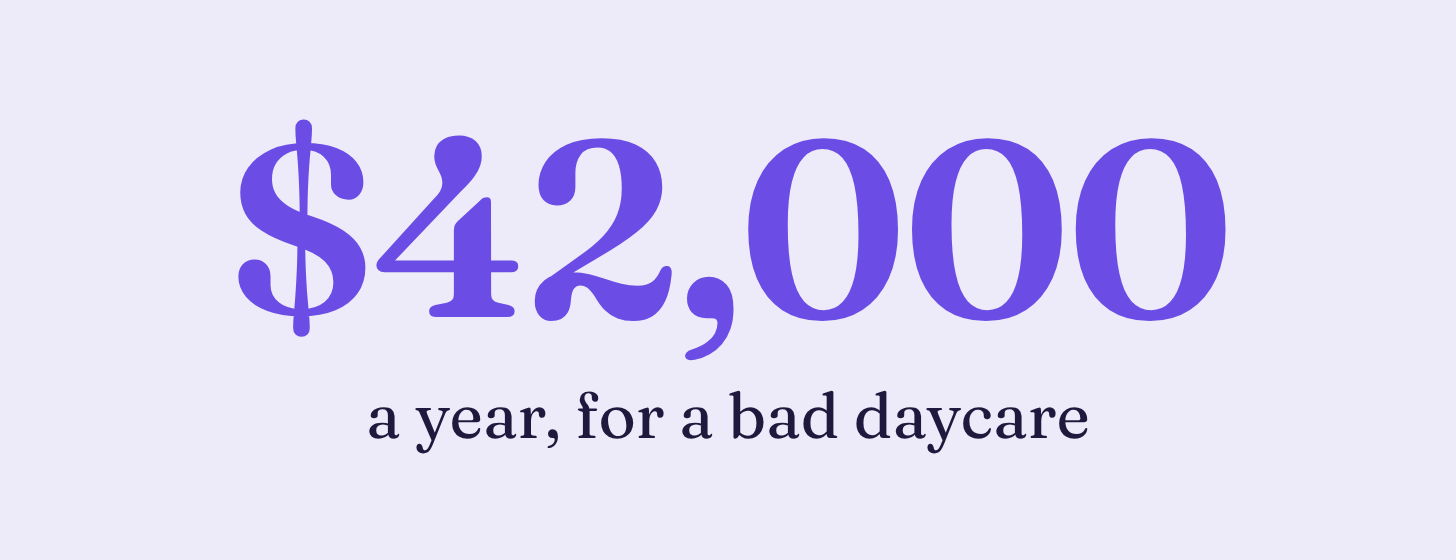
I realised that trying to juggle a full-time, demanding career while also navigating a for-profit, billion-dollar childcare industry (and every other big, daunting financial and logistical parenting decision in those first five years), with absolutely no guide — was a total setup for failure.
It was such a breaking point for me that I quit my career to be the mother I wanted to be, run the hardest business I’ve ever run (my own family) and share family strategy, so other parents wouldn’t have to suffer through the same lost time, money and unnecessary guilt I did.
Why maternal intuition is not enough
Before I had my son, I knew nothing about babies and children. Everyone told me not to worry because once my baby arrived, my maternal intuition would kick right in. Just trust your gut, they’d say. You’re the mum, you’ll just know what to do.
But parenting today has become so phenomenally complex.
As it turns out, my gut could not properly audit a daycare’s ownership structure and business incentives.
It could not model the lost income and superannuation of my five-year career break and determine if it was worth it.
It could not tell me whether $40,000 a year in private school fees would buy a better outcome for my child than the same money in a house deposit.
Then I realised these are not intuition problems. They’re strategy problems. And like me, Australian parents are drowning in them. We have five-figure childcare bills, the worst housing affordability on record, career decisions with six-figure consequences — all to be faced while sleep-deprived, emotionally overwhelmed, and buried in information overload. It’s become a breeding ground for decision fatigue and paralysis.
I had spent fifteen years in business solving strategy problems. It just hadn’t occurred to me to use those skills in my parenting.
What I actually do
I qualified as a Chartered Accountant and hold a Master of Professional Accounting. I started in Big Four audit at KPMG in Canada, moved into enterprise risk consulting, and then spent eleven years at Google across internal audit, value consulting and commercial strategy roles in the US and in Australia. I built financial models and ROI cases for some of the largest companies in the world. I also run a private property portfolio across three states, which means the housing decisions in my writing come from a practitioner rather than a theorist.
The Gap
When I was pregnant, I couldn’t find strategic parenting advice anywhere. What I found is that parenting books generally come in two flavours:
Medical and physiological — sleep, feeding, development. Very useful (although often overwhelming), and completely silent on money and logistics.
Personal finance — also genuinely helpful, but written cold and technical, ignoring the time-poor and emotional nature of parenting.
Nothing existed in the middle. Nothing took the emotional weight of these decisions seriously and ran the numbers, analysed the data and came up with a thoughtful strategy to help you make them.
What you'll get
A weekly essay, every Wednesday morning, sharing the best of business, applied with heart to the high-stakes parenting decisions that ambush you in the first five years. (Well, that’s my elevator pitch anyway.)
The basis of it is a framework I built called DRIVE — five tools from business, which I adapted for family life:
Data — what the research actually says, once you strip out the social media noise.
Reversibility — borrowed from Jeff Bezos; eliminates decision paralysis by separating irreversible choices from low-risk experiments.
Insurance — asking what could go wrong before it does, on the decisions where you have the least control and most uncertainty.
Values — replaces the limited pro/con list with a values matrix, weighing multiple complex choices honestly against what matters most to you.
Economics — the true long-run cost of a commitment, including the hidden costs, opportunity costs and sunk costs.
We’ll cover the big decisions the way a strategist would. Over birth and postpartum, childcare and schooling, parental leave and career pivots, household finance and property. Every framework in here has been stress-tested on my own family first, including the decisions I got wrong and wish I could do over.
Why Subscribe
Because if you are family planning, expecting, or somewhere in the first five years, at some point you’ll be faced with a decision worth tens of thousands of dollars and several years of your life. It’s better to have the data, numbers and a framework ready than to make it emotionally, on the brink of exhaustion. You don’t need more parenting advice. You need a strategy.
— Christina
Excellent concepts for soon-to-be or new parents! I look forward to the weekly essays