

For-profit daycares are not typical businesses. We are not just customers paying for a service. We are families handing over our babies, who cannot talk, to businesses that have them completely unobserved all day, and that are financially incentivised to spend as little as possible on them in order to maximise returns. It may sound paranoid, but it’s a reality here in Australia.
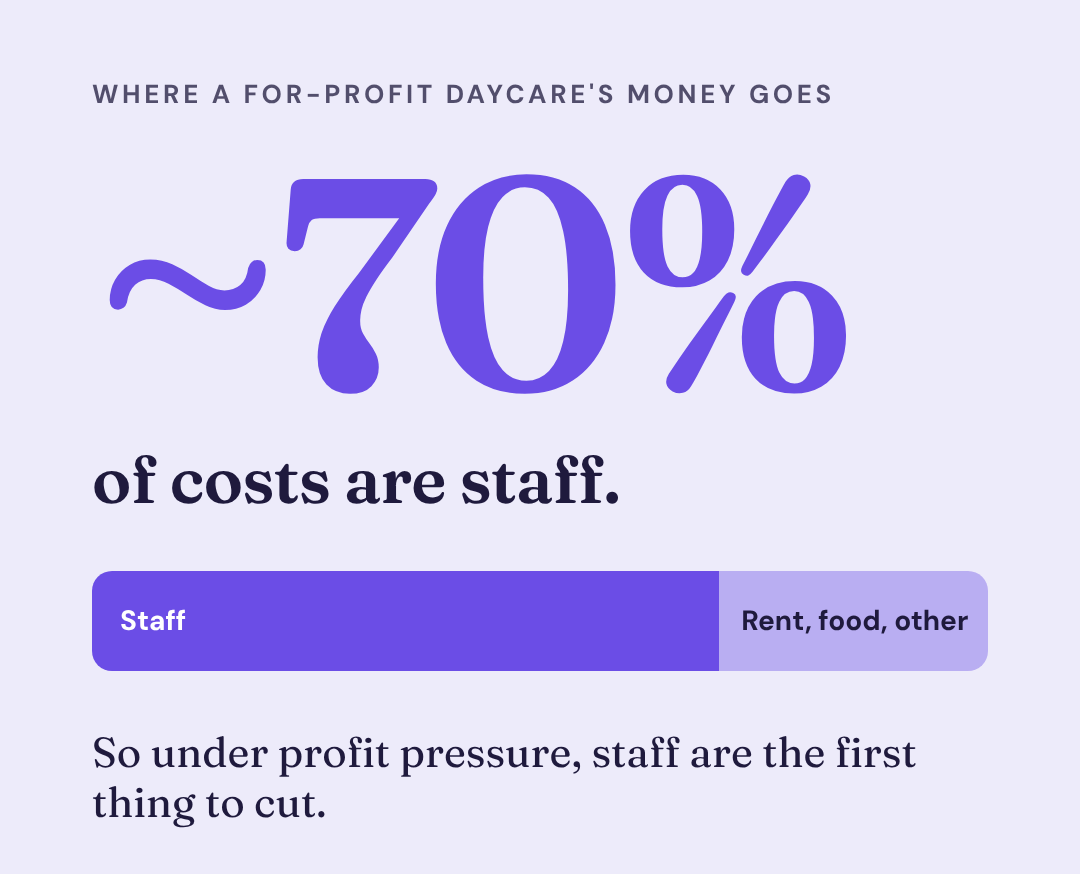
I spent 15 years in business and eight of them auditing companies. This is just how businesses work. Roughly 70% of a for-profit daycare’s costs are staff, so it’s often the first thing to cut when they’re facing profit pressure. It’s also the most damaging thing to cut for our children because it translates into underpaid staff, less qualified staff or the legal bare minimum of supervision required (and often below that).
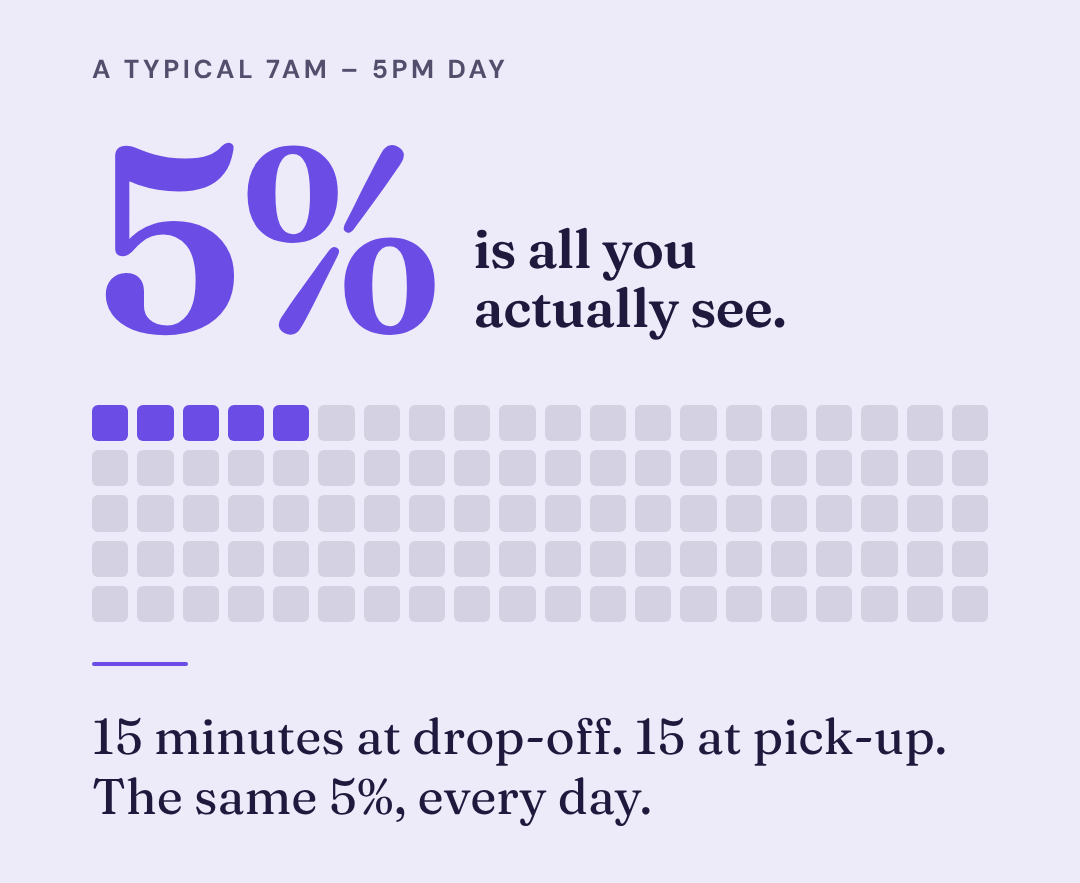
Not all daycares are unsafe. Some are good, some are bad. The challenge for parents is figuring out which is which when we only see 5% of their day at drop-off and pick-up and from the outside, they all look relatively the same.
Here are the simple checks you can do to make sure yours is a good one.
At your laptop
1. Look up your centre on Starting Blocks — who owns it, the NQS rating, any enforcement actions, and the financials.
All providers must disclose their National Quality Standard rating and enforcement actions, and large providers must also disclose their financials (revenue and profit data). A large provider is one with 25 or more centres. Large for-profit providers are more than three times as likely to have an enforcement action recorded against them as other large providers (Mitchell Institute, 2026). When you combine scale with cost pressure, the result is profits before children. But it’s hard to know if your lovely little daycare with the cute name is part of a big chain, private equity backed or part of a publicly listed company. So look it up on Starting Blocks to be sure.
If you go to a non-profit, they do not have the same financial incentives as for-profits. Non-profits are becoming increasingly rare (about a quarter of all centres in Australia), but you’ll know if you go to one, because it’s a selling point they’ll highlight.
2. Request the name of every educator in your child’s room, what days they work, and how long they’ve been there.
These people are changing your child’s nappy. You should know who they are. To make this easy, shoot your director this draft email.
Hello [Director],
I’d like to get a better picture of who’s caring for [my child] day to day. Would you please provide me with the names of every educator in [my child]’s room and include the following:
Are they full-time permanent, part-time or casual?
What days do they work?
How long have they been employed with the centre?
Thank you,
[Parent]
When you evaluate their response, what you want is:
Majority full time and permanent staff to ensure consistency of care
Alignment to your child’s days, which also impacts consistency (i.e. the same person, every day).
Long tenure and low turnover
That’s the dream, but we also need to understand that turnover in the sector is high. 52% of childcare jobs are held for less than one year, against 25% in the school sector (Mitchell Institute, 2026).
So if you get a response that every single person has been there less than a year, that is a red flag that warrants further questions. One or two familiar casuals are typical, but a revolving door is a problem. If the majority are long-tenured permanent staff (3-4 years) – that is actually quite good for the sector.
3. Put your name on another centre’s waitlist for next year. You don’t have to take the place – it’s just an insurance policy that doesn’t hurt.
One of the biggest barriers to switching is lack of availability and access when you need it. If possible, get on a waitlist elsewhere so you have options if you need them. It usually costs between $0-$50 and a few minutes of your time. It’s always helpful to have options so you don’t feel stuck if the time should come. And vet those centres properly too using the questions I outlined here.
At the centre
4. Ask about the cameras and go take a look. Where they are, how long footage is kept, and what the process is to request it.
CCTV isn’t mandatory in Australian childcare. So the first thing to establish is whether your centre has cameras at all, and where they point. A government trial is running CCTV across up to 300 small and medium operators.
Find out which rooms are covered, how long footage is kept before it’s overwritten, and what you have to do to request it.
Most centres won’t show you footage for privacy reasons (since other people’s children are in it). But if something awful happens, you want to know whether you can view it instead of finding out on the worst day of your year. At the very least, you want to know that it’s captured on video, so the centre or a regulator can view it if the incident wasn’t observed.
Also, cameras aren’t permitted in nappy change areas or toilets, which is why you need to check the layout yourself.
5. Take a look at the nappy change area, the bathrooms and the sleep room, and check the lines of sight.
These are the only times someone will likely be alone with your child, but you don’t want them to be completely alone.
What good looks like: a change table and toilets in an open flow room, so anyone walking past can see in. No space where an adult and one child can be behind a closed solid door.
Sleep rooms are the one to pay attention to because they’re dark, quiet, and it’s the one room you will never see while in use. Ideally there’s a monitor with the feed visible in the main room. Ask your centre how often sleeping children are physically checked.
6. Once in a while, turn up unannounced, or change the time of your drop-off or pick-up.
Don’t make this a habit, but do it at least once when it works with your schedule. Can you take a half day off and pick them up at lunchtime and see what they are actually eating compared to the menu? Let them be that lucky kid who gets a surprise early pick-up.
If you always drop off at 7am, you might be surprised by what the centre looks like at 9am, when every child has arrived and it’s running at maximum occupancy.
Under Regulation 157, a provider must allow a parent to enter the premises at any time their child is being educated and cared for. The only exceptions are if there is a court order, or a genuine safety risk in being there. The centre’s penalty for breaching it is $3,300. You have every right to do this.
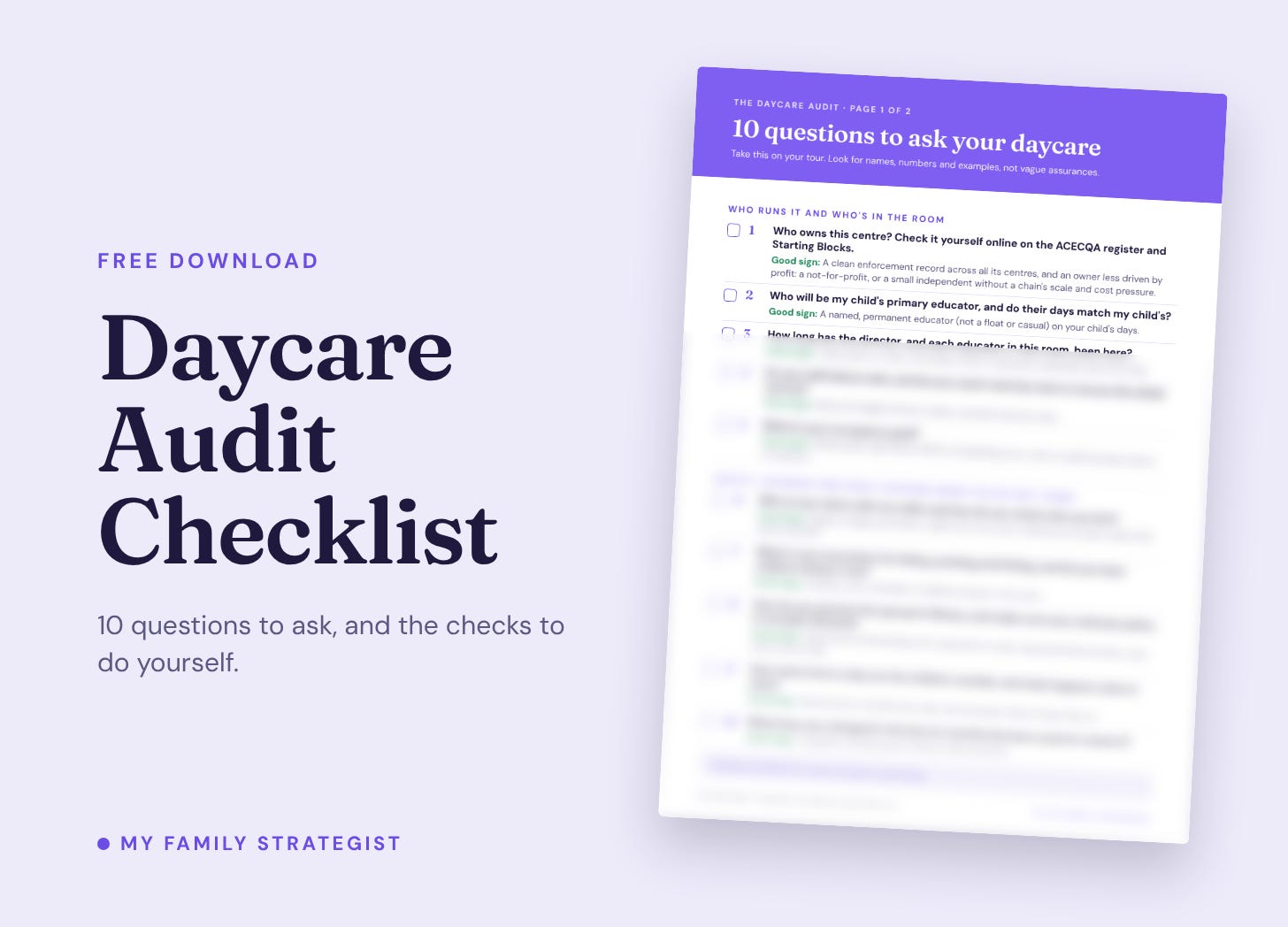
Subscribe to receive your free checklist (it’s the whole series on 2 pages)
What to watch for:
7. Do a headcount at drop-off and pick-up.
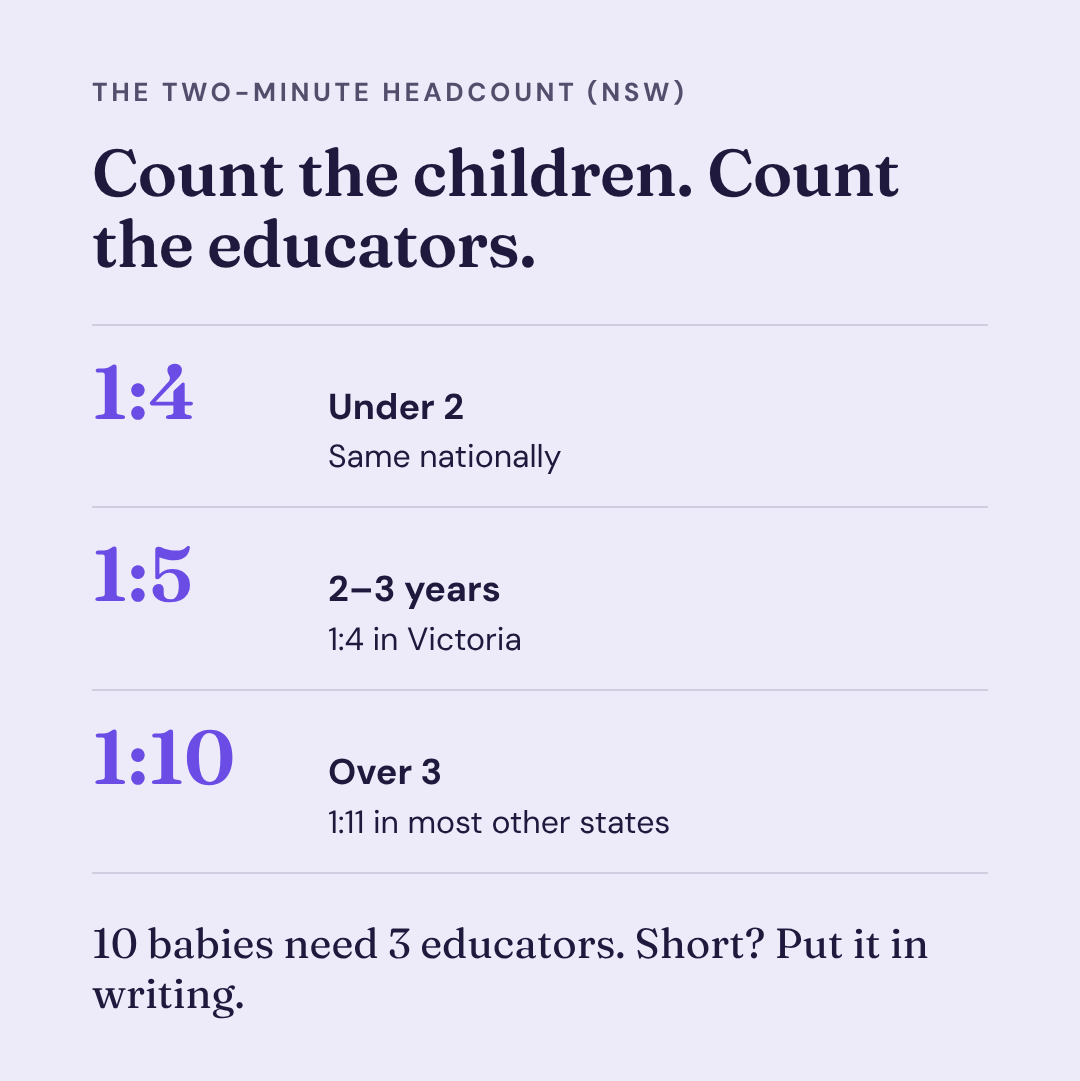
We do not have to wait several years for a regulator to assess whether supervision is adequate. We can do it ourselves every day, and it only takes two minutes.
In NSW the ratios are:
0–2 years, 1:4 (the same nationally)
2–3 years, 1:5 (1:4 in Victoria)
Over 3 years, 1:10 (1:11 in most other states)
Count the children. Then count the educators. If the room is below ratio, flag it immediately and put it in writing to your centre. If they’re relying on counting ratios across the whole service rather than per room (known as the “under the roof” rule) that’s perfectly legal, but inadequate supervision is not. Ask your centre whether they count ratios across the service or room by room. You want a centre that prioritises supervision and safety, not legal loopholes.
8. When an educator leaves, ask why — and ask more than one person. The director, the owner, and the staff.
You may get a different version depending on who you ask, and it tells you something about the centre.
When an educator suddenly left at our old centre, the director told me she was returning to university, but another staff member told me she was stressed and burnt out in the role.
At the next centre, the director left, and the owner said it was because of the commute, but the director told me herself she felt unsupported in the role.
I’m sure they were all telling the truth, but the different versions painted a fuller picture of the place I was entrusting with the care of my son. If I’d only asked one person, I wouldn’t have had that.
9. New face in the room? Ask for a profile, whether they’re permanent, and if they’re casual, why.
This is why you asked for the full list in #2. You already have the names, the days and the tenure of the staff, which is your baseline. Keep track of how often new people are coming in and how much change is actually happening in the room.
10. Notice when children disappear.
At my son’s old centre, I slowly watched what was once a room full of little boys turn into a room full of girls. Where did all the boys go? So I started remembering faces. I observed a slow, complete turnover of children over about six months. I realised I was being left out. These parents knew something I didn’t. And I had to learn it the slow and painful way because I wasn’t talking to enough of them. This makes #15 even more useful – get to know the other parents at your daycare.
Many parents aren’t fully transparent with their daycare about why they’re leaving. And many directors will not openly share if they left because they were unhappy or had repeated issues. So just pay attention. A revolving door of staff is a bad sign, and so is a revolving door of children.
11. Look at the photos closely.
Staged or candid? Does your child look happy?
This one is hard to notice. For myself, it was only obvious in hindsight when I moved centres and could actually compare two sets of photos side by side, which makes my tip #17 on how to trial a new centre even more important.
At my son’s first centre, I almost never saw a genuine smile. He looked engaged in the activities, but they were usually advanced for his age, like science experiments or cooking for 18-month-olds. Each baby separately photographed pouring a tablespoon of flour into the same bowl. In hindsight, it seemed like a setup. The photos and activities appealed more to parents than the children.
When I switched him, on his very first day I got so many candid shots of him laughing. I couldn’t believe it. I had never seen him so joyful. They weren’t doing complex activities, they were just left to explore on their own. I never would have noticed the difference if I hadn’t switched. I would have assumed all daycares were doing science for babies.
Look at the photos carefully, how many show your child doing something impressive, and how many show them just being a kid, laughing and having fun with their friends?
They will never post the moments where any child is crying or upset and of course those do happen. So take a critical look at all the others and you might find a pattern worth following up on.
Get it on the record
12. Never sign an incident report you haven’t read.
They tend to hand it to you at pickup while your child is pulling your arm and you’re in a rush to get home. So instead take a copy and ask your questions the next morning.
13. Give feedback in writing, professionally and politely.
The most helpful feedback is rooted in facts, supported with examples and devoid of emotions. Cite the number of incidents and the dates, keep a log. If they don’t take action, that’s a data point.
And know this before you start: if it’s a serious problem, the director may not be able to help you even if they want to. In a corporate structure, staffing budgets are set at the top and implemented across centres. So if it’s a big corporate chain, this will be challenging if there are multiple layers between you and a decision maker. In an independent centre, you’re more likely to have a straight line to the owner.
If it’s a breach or safety concern, report it to the regulatory body in your state. You can do so anonymously. In NSW that’s NSW Early Learning Commission.
Talk to People
14. Build real relationships with the educators.
Why wouldn’t you, really? If your child attends full time, they may spend more of their waking hours with them than with you.
Remember, 95% of your child’s day you will never see, but the educators see all of it. An educator who trusts you and likes you will tell you things. It was an educator I’d built a relationship with who told me about some of the centre’s bad practices. I was lucky to have that. Without it, I’d probably have stayed longer.
Realistically, we cannot expect educators to whistleblow or report their employer. The ones that do are incredibly brave. There is a tremendous power imbalance between the underpaid childcare worker and the multi-millionaire daycare owner. So instead just be the parent they’d want to tell privately.
15. Make friends with the other families at your daycare and share notes.
There is always power in numbers. Your centre can ignore feedback if it’s just coming from you. But it’s harder when six parents are requesting the same thing. Also if someone chooses to leave, that is information you’d like to know. What did they experience that you haven’t yet?
Introduce yourself, and exchange numbers. As a bonus, you can have more playdates and get to know more awesome families. Some of my best friends are ones I’ve met through Lando’s daycare.
Pay attention to whether your centre makes this easy or hard. A centre that connects families is one that isn’t worried about what you’ll compare. One that keeps you apart knows that six separate complaints are easier to manage than one shared one.
When I asked my old centre repeatedly about parent social events or exchanging numbers, I got a polite nod and zero follow-through. At the next one, I couldn’t keep up with the monthly daycare family events.
16. Ask educators questions about your child - how do they describe them? Does it line up with how they are at home?
Something was off when they’d tell me how quiet and shy my talkative social baby was. Of course we are all a bit different in public than at home, but the discrepancy shouldn’t be night and day. At his current centre, when they tell me stories about his day, it’s exactly how he is at home.
If every day is a "good day", ask follow-up questions once in a while. What did they do? Who did they play with? Any stories to share?
If you aren’t getting much back, either they don’t know your child or they haven’t observed their day, which tells you how much attention they’re getting.
And if it’s still not working:
17. Trial another centre one or two days a week before you commit to leaving.
If it gets to the point where you are considering switching, trial a new centre by moving your child only one or two days a week and compare. But keep your existing spot. It’s much easier to decrease or increase days, instead of withdrawing completely and re-enrolling if you change your mind.
Do a side by side comparison. You might be surprised at the difference in energy at drop-off, how warm the staff are, how receptive the director is, or generally how much better a centre can be run. But you’ll never know unless you try.