

Thank you so much to everyone who watched Four Corners, shared the news articles, and is supporting this movement for childcare reform.
I didn’t see any previews of Four Corners. I watched it live with everyone else. And I walked away with so many emotions: incredibly grateful for investigative journalism, heartbroken for the families featured (especially the family in Far North Queensland), and furious at a system that keeps failing our vulnerable children. Here are the parts of my story that didn’t make the final cut.
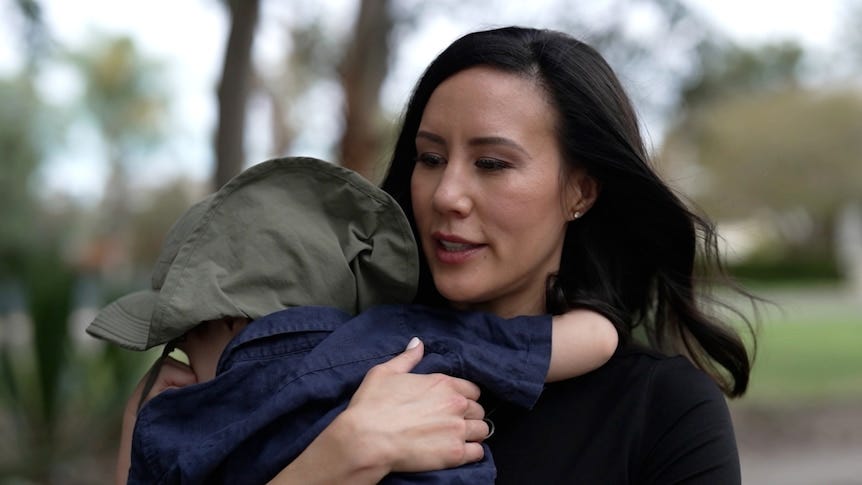
Christina Spark used her background as an auditor to dig into her son’s childcare centre. (Four Corners: Rob Hill)
1. No one teaches parents this
As a former auditor, I know now that if I’d checked what actually matters (the ownership, the enforcement record, and asked the right questions on tour), I never would have enrolled my son. Or at the very least, I would have pulled him out in two weeks instead of nine months. But I had no idea. Most first-time parents don’t. No one tells us the best question to ask isn’t “What do I pack in the daycare bag?” It’s “Who owns this centre, and how profit-driven are they?”
That’s why I’m running a free virtual workshop this Friday 6 Nov at 1pm: “Is your daycare safe? How to check” (scroll to the end for more info). Parents shouldn’t have to figure this out on their own.
Putting our children in childcare for the first time coincides with the most vulnerable time for a family — when we’re heading back to work. When we barely have our heads above water, trying to pay the bills and hold it all together. When we’re trying to figure out the new routine, and how to juggle work and being a parent (while sleep deprived and constantly sick from daycare germs). It’s not clear to many families —certainly not mine— that we are handing off our babies to companies who profit by spending as little as possible on them. It’s not clear to parents that there are specific things we can actually do to vet our centre, keep them accountable and keep our kids safe.
2. Good centres actually do exist
Our ending didn’t make it to air, but I want to share it here: our son is thriving. Thank you to everyone who sent us such lovely, supportive messages. After nine months at Little Zak’s, we moved him to a small, independently owned for-profit centre. It wasn’t fancy. They had no marketing budget, and the facilities were nowhere near as impressive. But this time I knew none of that mattered. I was armed with the right questions to ask and the warning signs to look out for:

My experience proved that good for-profit centres actually do exist. Here’s what good looked like, so you have a benchmark:
Ownership: The owner was very involved and onsite several days a week. I had a direct line to her, and she always acted quickly when issues came up.
Occupancy: Maximum capacity was under 40 children, but they aimed for 80–90% so the kids had breathing room. No bonuses tied to occupancy.
Ratios: They staffed the baby room at 1 educator to 3 babies, and they kept it up.
Staffing: Most staff were permanent and full-time. The culture was positive. Many sent their own children there, the ultimate vote of confidence.
Hygiene: Most of the day was spent outside, and children washed hands with soap and water before eating.
Layout: The nappy room and toilets were open, so anyone could see in.
About nine months later when my schedule allowed, I found a small not-for-profit centre with limited hours. So we switched again, and Lando was even happier. The non-profit centre raised the bar again:
No profit motive: Any surplus goes back into the centre, and fees were half what I’d been paying at the for-profit.
Small and well staffed: An even smaller group of children with staffing well above the legal ratios for every age group not just babies.
Experience: Most staff had been there more than a decade. Some several decades. These are very experienced educators, many with grown children of their own.
3. The best centres are disappearing
I wish amazing centres like mine were more accessible. Our centre’s limited hours means it doesn’t work for many working parents, and even good centres like ours are under pressure to survive.
Not-for-profits make up only about a quarter of long day care places, and almost all growth in the sector (98%, according to Four Corners) is for-profit. Not-for-profit staff are better paid and have higher quality ratings according to the ACCC and ACECQA.
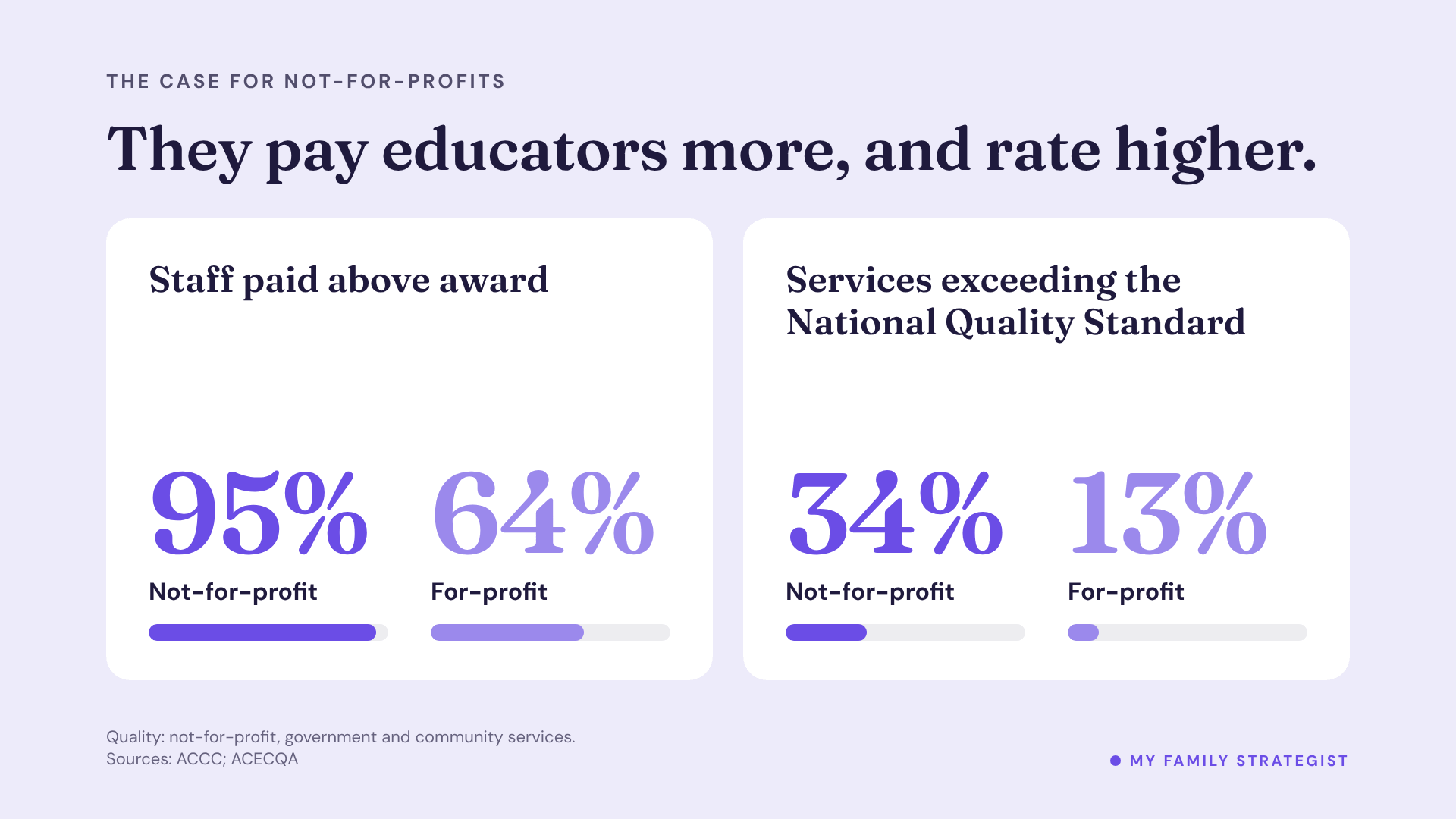
Parents need more choice. We can’t let the large providers with the worst records keep expanding while the good not-for-profits quietly disappear.
4. Many of the educators at Little Zak’s were kind, caring and compassionate.
It’s such an important part of the story, and unfortunately it did get missed. One educator always encouraged me to advocate for my son. She was incredible and all the kids loved her. Another thanked me for flagging understaffing to management. Sadly, when management did nothing about it, she quit from burnout.
Staffing levels are set by management, not educators. Our educators are raising the next generation, and they deserve to be paid and valued that way.
We need to look out for our educators too, not just our children. We do exactly that when we hold centre owners accountable. Talk to your educators and get to know them. And be the parent they’d feel safe telling if something was wrong.
Join me this Friday at 1pm: free workshop
I’m using my eight years of auditing companies, and my lived experience of navigating the daycare sector, to teach parents how to vet their centres properly and keep their kids safe.
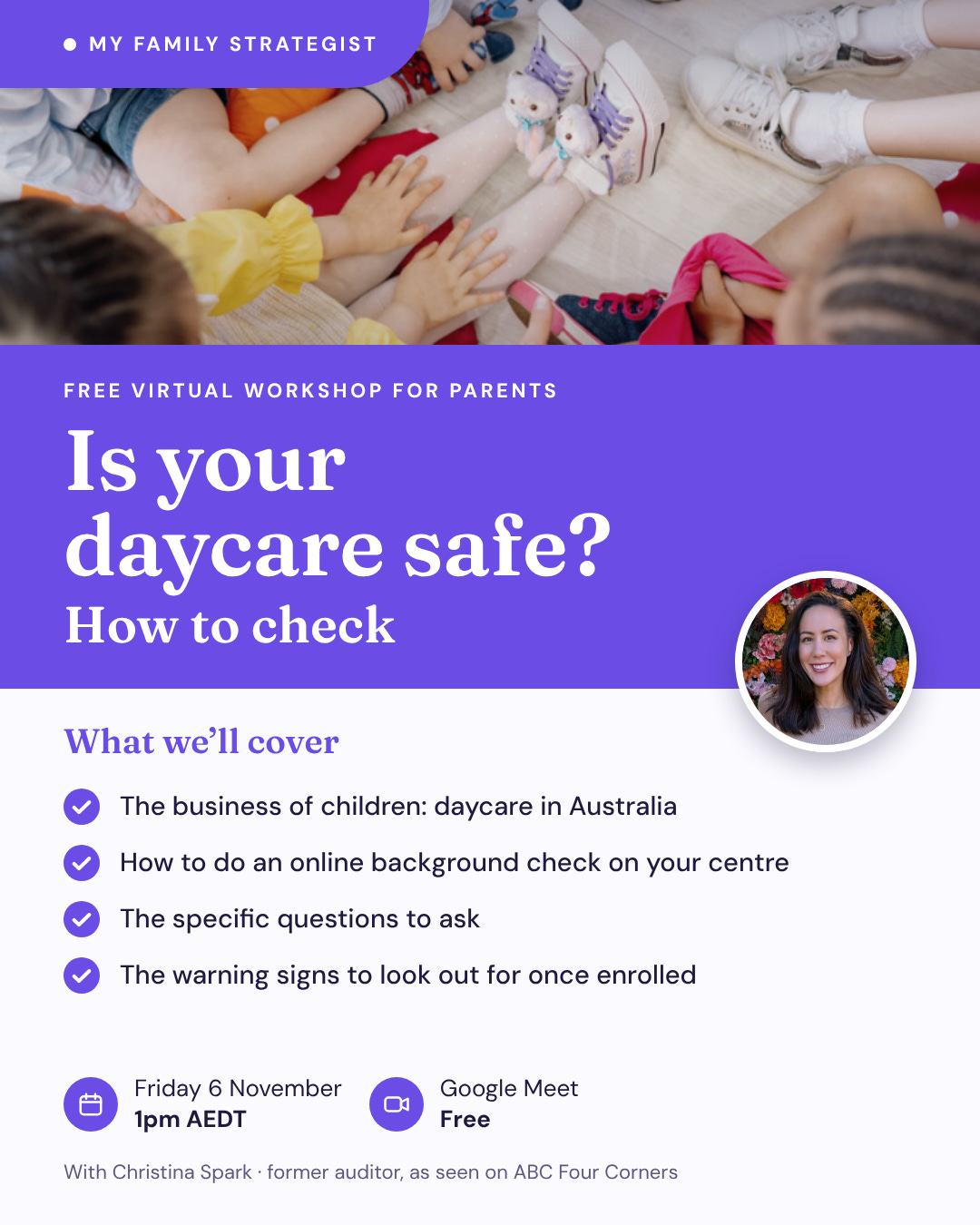
Please share with anyone navigating this. ❤️
Great article, one of the things that concerns me is that a ratio of one to three means that one carer is allowed to be alone with your child. The second thing that concerns me is that sexual abuse takes only a few seconds, many abusers do so in the company of other people in the building or room. Ashley Griffith recorded a lot of his offences, the ones he was convicted for and in several you could hear bystanders talking. Ratios won't solve this.